IRS Code 150: Simple Meaning and What to Check Next
IRS Code 150 on your tax transcript usually means the IRS has posted your return and recorded the tax for that year. In most cases, IRS Code 150 is a processing marker, not a warning by itself. That sounds serious, especially if you’re waiting on a refund, but the code itself isn’t automatically bad news.
The tricky part is that Code 150 doesn’t tell the whole story. The amount beside it may reflect tax before credits, withholding, payments, or later adjustments. The date beside it also isn’t the same as a direct deposit date, which is where many people get thrown off.
Before you assume you owe money or your refund is approved, look at the surrounding transcript codes. Code 846, 570, 971, and your account balance usually say more than Code 150 by itself. That’s where the real answer starts.
Key takeaways about IRS Code 150
Code 150 usually means your return has posted to your IRS account, but don’t treat it as the final answer. Read it with the amount, date, and nearby transcript codes.
- Code 150 shows the IRS recorded tax for that year.
- It does not mean your refund was approved.
- Code 846 is the stronger sign that a refund was issued.
- Codes 570 or 971 may point to a hold, review, or notice.
- A $0.00 amount can still need context.
- Check your full transcript before calling the IRS.
That one code is only the starting point.
What is IRS Code 150?
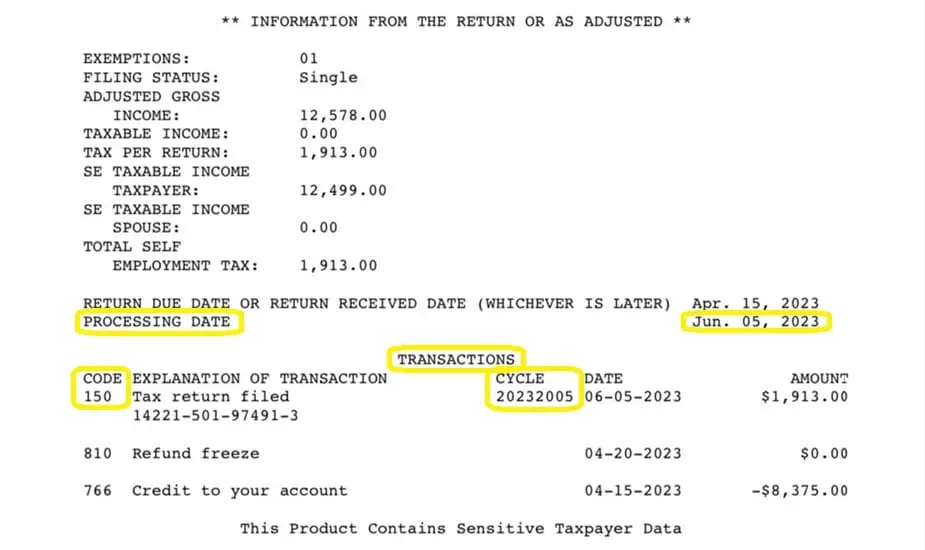
IRS Code 150 means the IRS has posted your tax return to your tax account and recorded the tax shown for that year. The 纳税人权益维护处 describes TC 150 as the filing date and the amount of tax shown on the return when filed, or as corrected by the IRS during processing. That sounds heavier than it usually is.
Think of it as the IRS saying, “We have the return in the system, and we’ve entered the tax number.” It does not automatically mean you owe that amount today. It also does not mean your refund has been approved, released, or delayed.
The common mistake is reading IRS Code 150 by itself. You still need to check the lines around it, especially credits, withholding, refund codes, holds, and notices. A transcript works like a running account history, so one code rarely tells the whole story. Start with Code 150, then follow the trail.
Does IRS Code 150 mean my refund is approved?
No. IRS Code 150 does not mean your refund is approved, even though it can feel like a major update on your tax transcript. It usually means the IRS has posted your return and recorded the tax side of the account, but refund approval is a separate step.
The code you really want to watch for is Code 846, because that usually points to a refund being issued. The IRS also says 我的退款在哪里 gives refund status after your return is processed, and refund delays can happen when a return needs correction or further review. So if you only see Code 150, you’re not at the finish line yet.
A simple way to read it:
- Code 150 means the return posted.
- Code 806 may show withholding.
- Code 766 or 768 may show credits.
- Code 570 may show a hold.
- Code 971 may show a notice.
- Code 846 is the refund-issued signal.
That order matters. A transcript can show Code 150, credits, and even a refund-looking balance before the IRS actually releases the money. This is where people get tripped up. They see a familiar refund amount, assume payment is coming, then miss a hold or notice sitting a few lines lower on the transcript. So don’t plan around the refund yet until the refund status tool or Code 846 gives you something more concrete.
What does the amount next to IRS Code 150 mean?
The amount next to IRS Code 150 usually reflects the tax the IRS recorded from your return, or the amount it corrected while processing the return. That number can look scary, but it is not automatically the balance you owe.
Here’s the part people mix up: tax assessed is not the same as final refund or final amount due. Your transcript may list the tax first, then show withholding, estimated payments, refundable credits, adjustments, or a refund code later. The 纳税人权益维护处 explains that transcript amounts can also appear as negative numbers when they are in the taxpayer’s favor, which is why one line can mislead you if you read it alone.
Read the amount beside IRS Code 150 with the rest of the account activity:
- If withholding or credits are larger than the tax, you may still be due a refund.
- If payments and credits are smaller, you may have a balance due.
- If the amount says $0.00, it may mean no tax was assessed on that line, not that the whole account is finished.
- If later codes change the account, the Code 150 amount may not be the final story.
The smart move is to compare the transcript to your actual tax return. Check Form 1040, total tax, withholding, refundable credits, payments, and any IRS adjustment codes. A number beside IRS Code 150 is a starting point, not a verdict. Especially if you are checking a refund during filing season, that distinction matters a lot today. That’s the detail that keeps you from panicking over the wrong line.
What does the date next to Code 150 mean?
The date next to IRS Code 150 shows when that return activity posted to your IRS tax account. It is not your refund deposit date, and it is not a promise that the IRS has finished every review tied to your return.
That date helps you place IRS Code 150 in the transcript timeline. The Taxpayer Advocate Service describes TC 150 as the filing date and tax amount shown on the return, or corrected during processing, so treat the date as an account marker, not a payout schedule. Big difference. A refund date usually matters more when you see Code 846.

Check what comes after that date. If you see credit codes, then Code 846, the account may be moving toward refund release. If you see Code 570 or 971 after Code 150, the IRS may have a hold, review, or notice in the system. So don’t read the date like a calendar promise. Read it like a timestamp in a longer story. That’s why the same transcript can feel updated but still leave you waiting for the next real signal.
Which transcript codes should you check after IRS Code 150?
The codes after Code 150 tell you whether the IRS is recording your return, moving toward a refund, or pausing the account for review. Start with the next few lines on your tax transcript before you assume the account is finished.
These are the main codes to check first:
| 代码 | 通俗易懂的含义 | 下一步检查什么 |
|---|---|---|
| 806 | 预扣联邦所得税 | Compare it with your W-2s and 1099s. If withholding is missing or too low, your refund may look wrong. |
| 766 | Credit to your account | Check which credit created the entry. Some credits reduce tax, while others may help create a refund. |
| 768 | Earned Income Credit | Look for timing rules, review codes, or notices if your refund has not moved. Refundable credits often get extra attention. |
| 846 | 已退款 | This is the code most refund-watchers want. It usually means the IRS released a refund for the listed amount. |
| 570 | 其他账户行动待定 | Slow down here. This may mean the IRS placed a hold while it reviews income, credits, identity, or another issue. |
| 971 | 发出的通知 | Watch your mail and IRS online account. A notice may explain what the IRS changed, needs, or reviewed. |
| 290 | Additional tax assessed | Compare it with your return. The IRS may have added tax after processing or adjustment. |
| 300 | Additional tax or deficiency assessment | This is more serious. Review the notice, deadline, and appeal rights if a letter follows. |
| 420 | 考试指标 | The return may be under exam consideration. Gather records instead of guessing. |
| 582 | Lien indicator | This points to a collection issue, not a simple refund update. Get help if you do not understand it. |
That is why IRS Code 150 should never be read alone. The 纳税人权益维护处 explains several common transcript codes, and H&S Accounting & Tax Services also has a simple transcript codes tool if you want to compare the surrounding entries. One line starts the story. The next few lines tell you where it is going.
What should you do after seeing IRS Code 150?
After you see IRS Code 150, don’t jump straight to “I owe” or “my refund is gone.” That code matters, but it’s only one line on your IRS transcript. The better move is to read the account activity around it.
Start here:
- Confirm the tax year. A 2023 transcript and a 2024 transcript can tell completely different stories.
- Check the transcript type. A 税单 or account transcript usually gives you more useful account activity than a basic return summary.
- Compare the Code 150 amount with your Form 1040, especially the total tax line.
- Look for withholding, estimated payments, or credit codes, such as 806, 766, or 768.
- Watch for hold or notice codes, especially 570 or 971.
- Check 我的退款在哪里 if you’re waiting on money.
- Gather your records before calling. Keep your return, W-2s, 1099s, payment confirmations, and IRS notices nearby.
Don’t skip the paperwork check. The IRS lets you request records through 获取成绩单, and that can help you verify the account instead of relying on one screenshot, one refund group comment, or one line that looks scary out of context.
This is where people lose time. They panic over IRS Code 150 when the real issue is a missing credit, a wage match delay, a payment that hasn’t posted, or a notice they haven’t opened yet.
So read the transcript in order. If the numbers match and you don’t see a hold or notice, you may only need to keep monitoring. If something doesn’t match your return, slow down and gather proof before responding. Guessing usually makes the process harder.
When should Code 150 make you look closer?
IRS Code 150 should make you look closer when it appears with a hold, notice, missing refund code, unexpected balance, or an amount that does not match your return. The transcript entry by itself is usually routine. The problem starts when the lines around it tell a different story.
Pay closer attention if you see:
- Code 150, but no Code 846 after your refund has been delayed longer than expected.
- Code 570, which may mean the IRS paused the account for review.
- Code 971, which usually means a notice was issued.
- An IRS Code 150 amount that looks much higher than the tax shown on your Form 1040.
- Missing withholding, estimated payments, or refundable credits.
- A refund tracker message saying your return needs more review.
- Earned Income Credit or Additional Child Tax Credit activity with no clear refund movement.
That does not mean something terrible happened. It means you should stop guessing and compare the transcript to your actual return.
The IRS says some refunds take longer when a return has errors, needs more review, or raises identity or fraud concerns. The Taxpayer Advocate Service also notes that refunds can be held because of missing returns, offsets, reviews, or notices.
So read the account like a timeline. If the transcript shows a hold or notice after the posted return code, gather your return, wage forms, payment proof, and any IRS letter before responding. That stack of paperwork is not exciting, but it keeps you from chasing the wrong problem.
When should you contact the IRS or a tax professional?
You may not need to contact anyone for IRS Code 150 alone, but you should reach out when your transcript shows a hold, notice, unexpected balance, missing credit, or a mismatch you cannot explain. Start with the IRS tools first. Calling too early usually does not move the refund faster.
Call or get help when:
- Where’s My Refund tells you to contact the IRS.
- You received an IRS notice and the deadline is close.
- Code 570 or 971 appears after IRS Code 150.
- Your withholding, payment, or credit entries do not match your records.
- You see business income, self-employment income, amended return activity, or multiple tax years involved.
- A balance appears and you do not understand why.
The IRS says Where’s My Refund gives the same refund information available to phone assistors, and calling does not speed up a refund. So use the call wisely. If the issue is simple, the IRS refund tool or a notice may be enough. If the transcript has several codes, missing income, missing credits, or collection language, a tax professional can help you compare the transcript with the actual return before you respond.
You can also review this guide on how to 致电国税局 so you have the right documents ready before spending time on hold. That preparation matters because one wrong assumption can turn a transcript question into a messy back-and-forth.
How H&S Accounting & Tax Services can help with transcript questions
If your transcript shows more than one confusing code, H&S Accounting & Tax Services can help you slow the problem down and read it in order. The goal is not to guess from one line. It is to compare the transcript with your return, payments, credits, notices, and IRS account history.
That matters when IRS Code 570, Code 971, missing credits, amended return activity, or an unexpected balance shows up. Those issues can point in different directions. A missing W-2 match is not the same as a refund offset. A notice adjustment is not the same as an audit.
H&S Accounting & Tax Services can review IRS notices, perform transcript review, compare the numbers to your filed return, and explain what may need a response. If the issue turns into a broader IRS matter, the firm can discuss scoped tax problems help. No guessing.
FAQs about IRS Code 150
Not by itself. IRS Code 150 usually means the IRS recorded the tax shown on your return, or an amount corrected during processing. To know whether you owe, check payments, withholding, credits, penalties, interest, and the account balance. One code doesn’t settle the whole account.
It is usually neutral. In many cases, it simply means your return posted to the IRS system. That’s useful, but don’t celebrate or panic yet. The surrounding codes matter more. Code 846 can point to a refund. Code 570 or 971 may point to a hold or notice.
Code 150 can appear before your refund is issued. Code 846 is the refund-issued code, so if it is missing, the IRS may still be processing the account, reviewing something, or waiting for another transcript update. Check Where’s My Refund too, especially if your transcript has not changed for several days.
Code 150 with $0.00 may mean no tax was assessed on that line. That does not always mean your refund is finished, approved, or denied. Look for credit codes, payment codes, refund codes, and notice codes. A zero on one line can still sit inside a transcript with other moving parts.
Usually, no. Don’t call just because you see IRS Code 150. Call if Where’s My Refund tells you to call, an IRS notice gives you a deadline, or your transcript shows a hold, mismatch, missing credit, or balance you cannot explain. Otherwise, keep checking the full account activity.
结论
IRS Code 150 is usually a sign that your return posted, not proof that your refund is approved or that you owe the amount shown. The code matters, but it is only one piece of your IRS transcript.
Read the full account before reacting. Check the amount, date, withholding, credits, refund code, hold code, notice code, and account balance. That is where the real answer usually sits. Code 150 starts the trail. The surrounding codes tell you where it leads.
If the transcript matches your return and no hold or notice appears, keep monitoring. If something looks off, gather your return, wage forms, payment proof, and IRS letters before you call or respond. IRS Code 150 is not the whole story, and treating it that way can send you in the wrong direction.