
Desbloquee los códigos de ciclo del IRS: ¡acelere su reembolso de impuestos!
Tax season’s great waiting game begins the moment you hit submit. That agonizing stretch between filing and funding? Pure suspense. Everyone checks ¿Dónde está mi reembolso?, but that tool’s vague “processing” status feels like staring at a blank calendar. IRS jargon doesn’t help, terms like “IRS cycle codes” sound like bureaucratic alphabet soup. But what if you could crack that code?
This guide tears down the mystery. Learn to find and interpret your IRS cycle code, the IRS’s internal timestamp that predicts WMR updates y deposit dates. We’ll cover Hollywood, FL-specific filing quirks, PATH Act delays, and why your account transcript beats the refund tracker. Ready to turn guesswork into a schedule?
What is an IRS cycle code?
An IRS cycle code is an 8-digit number (like 20250805) stamped on your account transcript. Think of it as the IRS’s internal shipping label, it marks exactly when your return entered their Master File system. That first digit group? The processing year (2025). Next two digits? The fiscal week (08 = late February). Last two? The batch day, revealing if you’re in daily or weekly processing.
Here’s the simplest analogy: imagine the IRS is a giant factory. Your tax return is a widget on an assembly line. The IRS cycle code is the exact date and shift your widget was stamped onto the conveyor belt. It tells you when the core processing “machine” started working on your specific return.
But here’s what most miss: These codes aren’t just for refund tracking. They’re also red flags for amended returns or audits. Spot a cycle code change mid-season? Your file’s likely under review. Always cross-reference with transaction codes, because that “20251405” might mean delays, not dollars.
Step-by-step: Finding your IRS cycle code
Forget ¿Dónde está mi reembolso?, it’s practically useless for this. Your IRS cycle code lives exclusively in your Account Transcript, the IRS’s unfiltered ledger. Head straight to the IRS Get Transcript portal, select “Online,” and prepare for Verificación de ID.me (yes, it’s a headache, but skip it and you’re locked out). Once inside, hunt for the “Transactions” section. Spot that eight-digit number in the “Cycle” column? Bingo, that’s your code.
Look for it right next to Transaction Code 150 (Tax Return Filed). That’s its most common home. If you don’t see an IRS cycle code next to TC 150, your return may not have entered the main processing system yet. It might still be in the initial “received” pile.
Consejo profesional: Third-party sites claiming “instant access” to cycle codes? Avoid them like tax scams. They’re data mines disguised as shortcuts. Stuck without a transcript? Your Hollywood, FL accountant can pull it via IRS e-Services, but DIY filers must tough out the portal. Annoying? Absolutely. But it’s the only legit backstage pass.
Decoding IRS cycle codes: A practical breakdown
Cracking your eight-digit IRS cycle code reveals the IRS’s behind-the-scenes schedule.
First four numbers? The processing year, 2025 handles 2024 tax returns. Next two digits? The fiscal week (01–52). Week “05” means early February, when IRS staffing finally recovers from New Year chaos. But those last two digits? That’s where Hollywood filers often stumble.
| Código | Day | Batch type | Update speed |
|---|---|---|---|
| 01 | viernes | Daily | Faster (2-3 days) |
| 02-04 | Mon-Wed | Daily | Faster (2-3 days) |
| 05 | Jueves | Weekly | Slower (7+ days) |
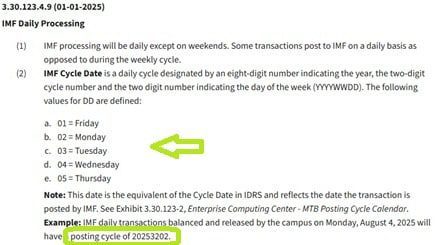
Spot an 05 ending? Welcome to the IRS’s weekly batch, updates crawl like I-95 traffic during Art Basel. Take code “20250503”: 2025, Week 5, Wednesday. Despite the Wednesday tag, it’s weekly processing because Week 5 mandates Thursday batches. Counterintuitive? Absolutely. Daily batches (01-04) zip through, but early filers often get stuck in weekly queues. Why? The IRS prioritizes backlog clearance before shifting to daily processing, a nuance most gloss over.
From cycle code to refund date: Realistic timelines
Got your IRS cycle code? Now let’s talk cash. TC 846 (the “refund issued” code) typically hits 1–3 days after your cycle date, if everything’s clean. But here’s the rub: daily batches (codes 01-04) update like clockwork, while weekly batches (ending in 05) drag like a humid August afternoon in Hollywood.
| Batch type | Cycle code ends In | Avg. refund timeline | PATH Act impact |
|---|---|---|---|
| Daily | 01-04 | 5-10 días | Delays until Feb 15 |
| Weekly | 05 | 14-21 days | Delays until Feb 15 |
El PATH Act is the ultimate buzzkill for EITC/ACTC filers. Even with a “20250405” code promising mid-January cash? Nope. Your refund gets frozen until February 15, and the IRS cycle code becomes almost irrelevant until that hold lifts. Pro tip: Stop obsessing over Where’s My Refund?. Your Account Transcript shows TC 846 48 hours before WMR updates. Found it? Funds hit in 1-5 days with depósito directo. Paper checks? Add 2 weeks and pray USPS doesn’t lose it.
Critical limitations: When cycle codes don’t deliver
IRS cycle codes aren’t crystal balls. Roughly 40% of Hollywood filers see refund timelines veer off-script, especially after 2023’s 4.7 million unprocessed return backlog. Why? Because the cycle code only tells you when processing started, not if it got stopped.
| Trigger | Code clues | Action required |
|---|---|---|
| Errores matemáticos | TC 290 ($0.00) | IRS auto-corrects (4-6 weeks) |
| Verificación de identidad | No TC 846 + cycle freeze | Fax docs to IRS ACS Unit |
| Audit flag | TC 420/424 | Respond via CP75 notice |
Spot a TC 570 (hold) or 971 (notice issued)? Your cycle code’s irrelevant until resolved. And forget weekly vs. daily batches, identity verification paralyzes accounts for meses. Case in point: A Surfside condo owner waited 19 weeks last year despite a “20251102” daily code. Tax pro secret? Transcript codes trump cycle digits every time.
Proactive steps for stalled refunds
Stuck in limbo de reembolsos? Don’t just stare at that frozen cycle code. Act fast:
- Pull fresh transcripts, yesterday’s data is worthless. Hunt for TC 846 (refund) or TC 570 (hold). Missing? Red alert. Look for the date next to your cycle code, has it passed with no activity? That’s your signal to investigate.
- Llame al IRS, but never endure 2-hour holds. Use our free Call the IRS playbook to reach a live agent in <2 minutes. Services like Claimyr cost $30 if you’re desperate. Have your cycle code ready to give the agent; it helps them locate your file faster.
- Respond to notices within 30 days. That CP05 verification letter? Fax docs to the ACS Unit immediately, delayed responses trigger account closures.
Prevention beats cure: archivo electrónico with direct deposit slashes errors. Triple-check SSNs and W-2 math before submitting, Hollywood gig workers mixing 1099s/W-2s are audit magnets. An accurate return is the best way to ensure your IRS cycle code leads to a fast refund.
FAQ: IRS cycle codes unraveled
Q: Can my IRS cycle code change after filing?
R: Yes, and it’s a major clue. If the IRS corrects math errors or launches a review, they often assign a new cycle code (like 20251205) to the adjustment. Your original cycle code freezes. A cycle code change often signals TC 290 or CP12 notices adjusting your refund.
Q: Why is my cycle code 20250505 but no refund?
R: Cue the frustration. Weekly batches (ending in 05) update only on Fridays. No TC 846 by Saturday? Check for holds (TC 570) or PATH Act delays. Still stuck? Pull new transcripts, yours might’ve shifted to daily processing and gotten a new, different cycle code you haven’t seen yet.
Q: Do amended returns have cycle codes?
R: Spoiler: They do, but it’s a parallel universe. Declaraciones modificadas get new codes like “2025” + “01–52” + “05”, processed separately via the IRS adjustment system. Track them via ¿Dónde está mi declaración modificada?, not transcripts. The cycle code for a Form 1040-X is completely disconnected from your original return’s code.
Q: My cycle code is from last month. Am I forgotten?
R: Not necessarily, but it’s a yellow flag. If your cycle code date is more than 21 days old and you see no TC 846 or TC 570, there’s very likely a hold. Your return is in a pile waiting for manual review. Time to call or get professional help.
Conclusion: Master Your Refund Timeline
IRS cycle codes pull back the curtain on tax processing, but they’re not magic. Decode them right, and you’ll spot refund timelines like a pro. Miss the fine print? PATH Act holds or TC 570 freezes turn predictions into fairy tales.
For Hollywood freelancers juggling gig income or condo owners facing IRS delays, that eight-digit code is just the opening act. When transcripts stall or cycle dates blink “error,” it’s cue for backup. H&S Accounting & Tax Services cracks these cases daily, using cycle code analysis alongside full transcript reviews to fix math errors, fast-track ID verification, and turn IRS standoffs into cleared checks.
Don’t just know your code, understand what it’s trying to tell you. Programa una consulta before your refund becomes next season’s problem.