IRS Code 150 Simplified: A Quick Guide for Taxpayers
Let’s cut through the confusion: IRS transcripts look like alphabet soup, and “tax code 150” is that cryptic ingredient leaving you guessing. You’re not alone if you’ve stared at your transcript wondering, “What does this mean for my refund… or my wallet?”
Here’s the good news: IRS Code 150 isn’t a red flag or a secret penalty. It’s your tax return’s first milestone. Think of it as the IRS saying, “We’ve got your file, and the gears are turning.”
In the next 5 minutes, you’ll learn:
- What IRS Code 150 realmente means (spoiler: it’s good).
- How it impacts your refund timeline or tax bill.
- Pro tips to decode dates, numbers, and next steps.
No jargon. No panic. Just clarity. Let’s turn that transcript from bewildering to empowering.
What does code 150 mean on IRS transcript?
IRS Code 150 isn’t a verdict, it’s a green light. When this three-digit code pops up on your transcript, the IRS is saying: “We’ve got your return, and the clock is ticking.” Let’s break down what that actually means for you.
At its core, IRS code 150 does three things:
- Confirms acceptance: Your return passed the initial sniff test, no missing signatures or glaring errors.
- Creates your tax file: The IRS opens a “case” for your current tax year.
- Starts the clock: Processing begins, whether you’re owed a refund or might owe taxes.
You might see a dollar amount next to Code 150. Don’t panic. This figure reflects your preliminary tax liability: what you’d owe antes de credits, deductions, or payments are applied. It’s like a rough draft, not the final bill.
Think of it as the foundation of your tax account for the year. The IRS system has now built its initial record based on your submission, and all future actions (whether a refund, a notice, or an audit) will reference this established starting point.
Por qué es importante: Code 150 is your starting line. It doesn’t predict refund size or audit risk. It simply means your return is in the system, moving through the IRS’s workflow. For context, the IRS processes over 160 million returns annually – yours is now officially in the queue.
Consejo profesional: Pair Code 150 with your IRS account dashboard for real-time updates. If numbers make you dizzy, IRS.gov’s transcript guide deciphers every line.
Bottom line? Tax code 150 is progress. What happens next depends on your return’s details and we’ll tackle that in minutes.
Where does IRS code 150 live on your transcript?
Think of your IRS transcript as a treasure map and IRS code 150 is the first “X” marking the spot. But where exactly do you dig? Let’s navigate the layout.
Here’s how to find tax code 150 in three steps:
- Access your transcript: Log into your Cuenta en línea del IRS. Under “Tax Records,” select “Get Transcript” and choose “Tax Account Transcript” for the current year for the clearest view of your filed data alongside codes..
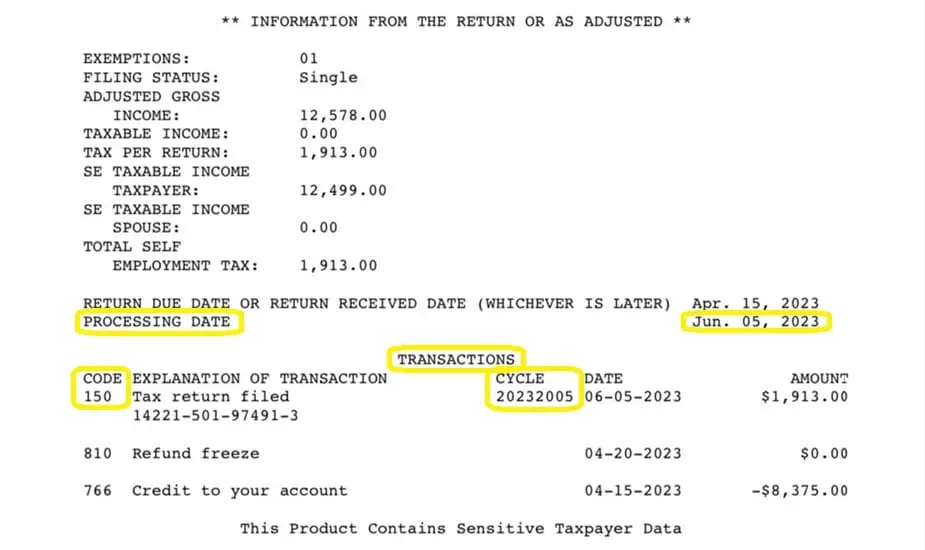
- Scan transaction codes: Scroll to the “Transactions” section. Code 150 typically appears early, near the top.
- Check dates and amounts: Look for a date (the IRS processing start) and a dollar amount (your initial tax liability).
Still lost? Code 150 often lurks under headers like “Account Activity” o “Transaction Codes.” If your transcript resembles a spreadsheet, focus on the leftmost column: the codes are listed numerically.
Consejo profesional: Use our Transcript codes tool as a decoder ring. It cross-references every code, including tc 150, so you’re never guessing. Bookmark it, you’ll use it more than once.
Once spotted, tax code 150 is your anchor. Everything that follows – refunds, adjustments, or notices – stems from this starting point.
Why IRS code 150 matters more than you think
IRS Code 150 isn’t just bureaucratic fine print – it’s your tax return’s heartbeat. Here’s why this unassuming code deserves your attention:
- It’s your processing confirmation
IRS Code 150 is the IRS’s way of saying, “We’re officially working on your case.” No more guessing if your return landed in a digital void. - It anchors your timeline
The date next to Code 150 marks day 1 of the IRS’s 21-day processing sprint (for e-filers). This is your reference point for tracking refunds or bills. - It reveals your starting liability
The dollar amount listed? That’s your baseline tax bill antes de credits, deductions, or payments kick in. Think of it as a “pre-score” in a game where rules can still change.
Myth buster: A high number next to IRS Code 150 no mean you owe the IRS. One taxpayer saw a $12,000 liability vanish after education credits were applied. Always wait for final processing. The code is a snapshot, not the final photo.
Consejo profesional: Pair Code 150 with the IRS’s Where’s My Refund? tool for real-time updates. If numbers spike your anxiety, IRS Publication 1 explains your rights as a taxpayer. In short, Code 150 is your compass. It won’t predict storms, but it’ll help you navigate what’s ahead.
How long after code 150 will I get my refund?
So Code 150 is live on your transcript – and you’re likely asking, ‘How long after Code 150 will I get my refund?’ Let’s map out the IRS’s behind-the-scenes workflow to answer that. Once your return enters the system, the clock starts ticking toward your refund or bill.
Here’s the typical post-Code 150 journey:
- Verification (days 1-5): The IRS cross-checks your income, deductions, and credits against W-2s, 1099s, and prior-year data.
- Error checks (days 6-14): Math errors? Missing forms? This is when the IRS flags issues. Most returns pass smoothly.
- Adjustments & offsets (days 15-18): Credits (like Earned Income Tax Credit) are applied. Debts (e.g., student loans) may reduce your refund.
- Refund or bill issuance (days 19-21): The IRS either releases your refund via direct deposit or mails a notice of balance due.
E-File vs. Paper Filing:
- archivo electrónico: 90% of refunds hit accounts within 21 days.
- Paper returns: Add 4-6 weeks for mailroom processing before the 21-day clock even starts.
Delays happen. Here’s why:
- Missing forms: Forgot a 1095-A for healthcare? The IRS will pause and ask.
- Identity verification: Random audits or fraud checks add up to 60-90 days.
- Errores matemáticos: A typo in your taxable income? The IRS corrects it and notifies you. This generates a CP01 Notice and a Code 290/291 for adjustment.
Consejo profesional: Track progress weekly with the IRS Where’s My Refund? tool. If day 22 passes with no update, call 800-829-1040. Code 150 starts the race but patience is your best co-pilot.
Cracking the code: Dates, numbers, and dollar amounts
The date beside Code 150 isn’t just any date. This is the IRS’s “start date” for processing your return. If you filed electronically on April 5 but see “April 8” here, don’t stress. The IRS batches returns weekly, so slight delays are normal.
Cracking cycle codes
Often near Code 150, you’ll spot an 8-digit “Cycle Code.” A code like 20241503 breaks down like this:

- First 4 digits: The year (2024).
- Next 2 digits: The IRS processing week (15th week = early April).
- Last 2 digits: Day of the week (01 = Monday, 05 = Friday).
Example: Tax cycle code 20241503 means your return was processed on Wednesday of the 15th week in 2024. This code tells you when the IRS system updates your account, which is key for knowing when to check back for new codes like 846 (refund issued).
Code 150 IRS with amount
That number beside IRS Code 150? It’s your preliminary tax liability: what you’d owe si no credits, deductions, or payments existed. One filer saw $8,000 here, but after child tax credits, their bill dropped to $0.
Consejo profesional: Cross-reference this data with your original return. If numbers clash, review for errors using the IRS’s Transcript Glossary. A mismatch could be a simple typo or a sign the IRS hasn’t yet processed a key form you submitted.
Bottom line: Code 150’s companions aren’t random. They’re breadcrumbs leading to your refund or your next move.
FAQs: Your top IRS code 150 questions answered
1. Does IRS code 150 mean I’m getting a refund?
Not yet. Code 150 confirms your return is processing, it doesn’t predict refund approval. Track refund status via ¿Dónde está mi reembolso? or look for the golden ticket code, Code 846, on your transcript.
2. Why is there a 0 next to IRS code 150?
IRS code 150 with 0 balance means your credits/deductions erased your tax liability. Congrats! This often signals a refund, but check for Code 846 (refund issued) to confirm.
3. What codes follow IRS Code 150?
Watch for:
- Code 846: Refund approved and sent.
- Código 570: Processing hold (needs review).
- Código 971: IRS notice mailed (often paired with 570).
Code 766/767: Credits applied (like Child Tax Credit).
Full list: IRS transcript codes.
4. Is Code 150 good or bad?
It’s objectively good news. It means you’ve cleared the first major hurdle. No news is worse than Code 150, at least now you know your return is actively in the system.
5. I amended my return, will I see a new Code 150?
Yes. If you file a form 1040-X, the IRS will process it as a separate adjustment. Once they begin that work, you’ll see a new Code 150 posted to your transcript for the amended return, often with a different date and cycle code.
¿Sigues atascado? Servicios contables y fiscales de H&S decodes transcripts y handles IRS chats.
Conclusion: Take control of your tax journey
IRS code 150 marks the beginning of your tax journey, not the destination. It’s the IRS’s way of confirming your return is in motion: whether that leads to a refund, a bill, or further questions depends on the steps that follow.
Once your file is moving, monitoring updates like Code 846 (refund issued) or Code 570 (account hold) removes the guesswork. But let’s face it: Transcripts can feel like riddles, especially when dates or dollar amounts don’t align with expectations. Understanding Code 150 gives you the confidence to know what stage you’re in and what to realistically expect next.
If your refund timeline stalls or numbers clash, professional guidance cuts through the chaos. Servicios contables y fiscales de H&S specializes in translating IRS jargon into clear next steps. From resolving holds to maximizing refunds, we handle the details so you can breathe easier.
Don’t let tc 150 be the end of your knowledge, make it the start of your confidence. Now that you know what it means, you can watch your transcript with the understanding of an insider, not the confusion of an outsider.