Código 806 del IRS en tu transcripción: significado y próximos pasos
Ver el código 806 del IRS en tu transcripción de impuestos puede hacerte sentir que tu reembolso está por llegar, pero ese código no aprueba el reembolso por sí solo. Por lo general, indica que se han contabilizado en tu cuenta retenciones federales o créditos por retenciones relacionados, especialmente si parece que el estado de tu reembolso está estancado.
Esta es la distinción importante: el crédito por retención ayuda a calcular lo que se te podría adeudar, mientras que la aprobación del reembolso depende del panorama completo que ofrece el historial fiscal. Aún así, debes revisar el monto, la fecha junto al código, tus formularios W-2, cualquier formulario 1099 con retención de impuestos federales y los códigos adyacentes que puedan indicar una retención, un aviso, un bloqueo o un problema con el reembolso.
No te bases en una sola línea. Lee el código teniendo a la vista la instrucción `return` y los registros. Ahí es donde empieza la verdadera respuesta.
Puntos clave sobre el artículo 806 del Código del IRS
- El artículo 806 del Código del IRS suele significar que el IRS ha acreditado en tu cuenta fiscal una retención federal o un crédito por retención relacionado.
- Un monto negativo junto al código puede ser positivo, pero eso no significa que tu reembolso haya sido aprobado.
- La fecha que aparece junto al Código 806 no es la fecha de tu depósito directo. Busca el Código 846 para conocer la fecha de emisión del reembolso.
- Compara el monto con tus formularios W-2, 1099, el formulario 1040 y el resumen de salarios e ingresos cuando sea necesario.
- Si ves los códigos 570, 971 u 810 cerca, reduce la velocidad. Esos códigos pueden indicar una suspensión, un aviso o una congelación.
¿Qué significa el código 806 del IRS en un extracto de impuestos?
El artículo 806 del Código del IRS significa que el IRS acreditó impuesto retenido o ciertos montos de retención relacionados en tu cuenta para ese año fiscal. En la mayoría de los casos, esto se debe a impuestos retenidos antes de que presentaras tu declaración, no a una decisión de reembolso por separado.
La entrada puede provenir de varios lugares:
- Retención del salario: Revisa la casilla 2 de cada formulario W-2. Esa es la retención del impuesto federal sobre la renta que tu empleador declaró como retenida.
- Impuestos retenidos en los formularios 1099: Los pagos por jubilación, desempleo, retención de respaldo u otros conceptos también pueden estar sujetos a retención federal.
- El monto declarado en tu declaración: El dato que figura en el estado de cuenta debe coincidir con el total de retenciones que aparece en el Formulario 1040.
- Exceso de FICA en casos limitados: Si tuviste más de un empleador, es posible que se te hayan retenido de más impuestos del Seguro Social o del RRTA. El IRS explica esto de la siguiente manera: retención en exceso.
No te detengas en la primera línea. Revisa primero toda la cuenta.
El código 806 del IRS es un asiento de crédito. Eso es importante. Ayuda al IRS a calcular tu cuenta, pero aún necesitas los códigos adyacentes para saber si realmente se ha procesado un reembolso.
¿Significa el código 806 del IRS que tu reembolso está aprobado?
No. El artículo 806 del Código del IRS no aprueba tu reembolso. Te indica que el IRS ha acreditado un crédito por retenciones en la cuenta, generalmente proveniente de impuestos retenidos de tu salario u otros pagos. Ese crédito puede contribuir a generar un pago en exceso, pero es solo una parte del resumen.
El código que más influye en la liberación del reembolso es Código 846. El código 846 suele significar que el IRS ha emitido un reembolso después de que la cuenta haya completado los trámites necesarios para liberar el pago. El Servicio de Defensa del Contribuyente describe el código de transacción 846 como emisión de reembolsos cuando los créditos y las retenciones superan el impuesto adeudado y no hay ningún impedimento relacionado con la declaración que bloquee el reembolso.
Aquí es donde el informe puede volverse complicado. El código 806 del IRS puede aparecer incluso cuando otro código, como el 570, el 971 o el 810, indique una revisión, una notificación enviada por correo o una suspensión de reembolso.
Así que lee toda la secuencia antes de dar por hecho que el dinero ya está en camino. Compara el monto retenido, revisa las fechas y busca el código de emisión del reembolso.
¿Por qué el Código 806 aparece como un monto negativo?
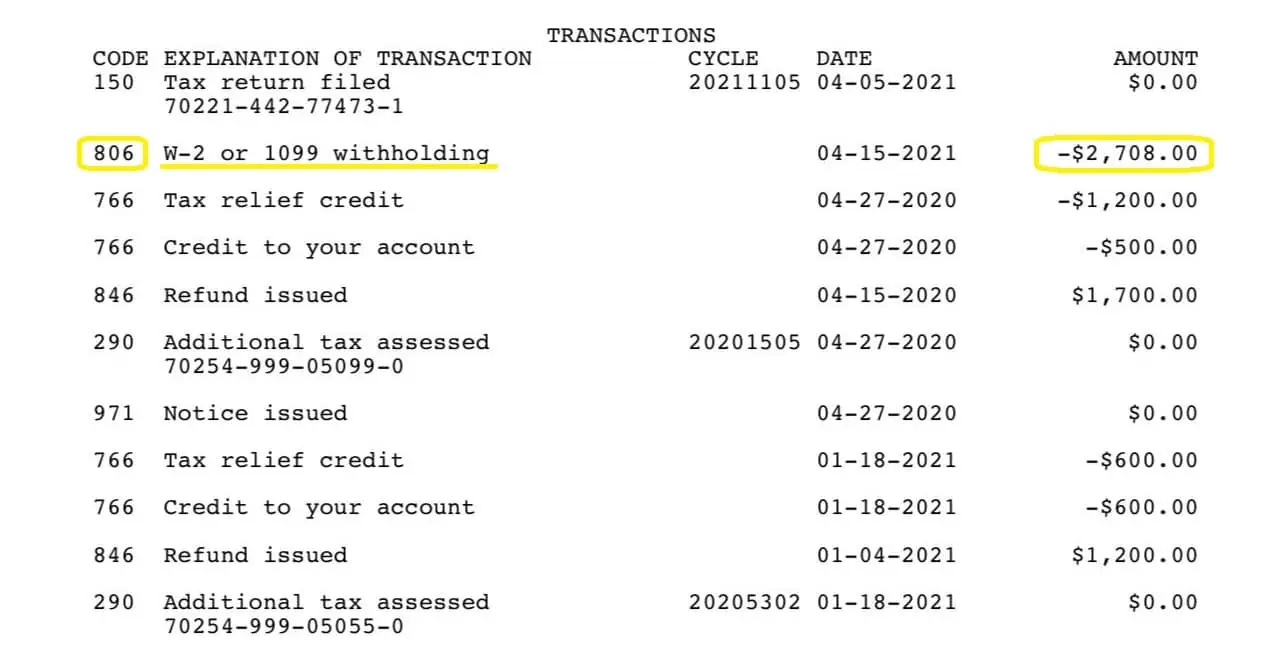
Un monto negativo junto al Código 806 suele significar que el IRS está reflejando esa retención como un crédito en tu cuenta. Esto puede parecer contradictorio si esperabas un número positivo, pero los extractos del IRS suelen utilizar montos negativos para los créditos, los créditos por retenciones y otros conceptos que reducen lo que debes. El Servicio de Defensa del Contribuyente explica que estos cantidades negativas pueden ser montos a favor del contribuyente.
De todos modos, no consideres esa cifra como el monto de tu reembolso.
El Código 806 del IRS solo muestra un asiento de crédito. Tu reembolso real depende del cálculo completo de la declaración: impuesto adeudado, créditos reembolsables, ajustes, retenciones en la cuenta, posibles compensaciones y si el código 846 muestra posteriormente la emisión del reembolso. Así que, si el monto del 806 parece favorable, eso es útil. Simplemente aún no es la respuesta definitiva en el estado de cuenta.
¿Qué significa la fecha que aparece junto al Código 806 del IRS?
La fecha que aparece junto al Código 806 del IRS no es la fecha en que se depositará tu reembolso. Es mejor interpretarla como una fecha de registro o contable relacionada con la forma en que el IRS contabiliza ese crédito por retención en la cuenta.
Esa fecha aún puede ser útil. Compárala con el Código 150 (declaración enviada), los Códigos 570 o 971 (posible retención o notificación) y el Código 846 (reembolso otorgado). Si las fechas te parecen confusas, códigos de ciclo pueden agregar contexto temporal, pero no anulan los códigos de transacción.
No te bases únicamente en la fecha 806. Para que se considere una fecha de reembolso, se necesita un registro de reembolso emitido, no solo un crédito por retención que figure en el expediente. Revisa primero la secuencia y luego el monto antes de tomar cualquier medida.
¿Cómo debes comparar el Código 806 con tus formularios W-2, 1099 y tu declaración de impuestos?
Compara el artículo 806 del Código del IRS con los documentos de retención que acompañan a la declaración, no con el monto del reembolso que esperabas. Antes de agregar nada, confirma el año fiscal. Si el año es incorrecto, la respuesta también lo será.
Revisa los números en este orden:
- Tire del transcripción fiscal para el año fiscal. El IRS permite a los contribuyentes acceder a registros fiscales, expedientes académicos e información sobre salarios e ingresos, ya sea en línea o por correo.
- Revisa primero el extracto de la cuenta fiscal, ya que ahí aparecen los códigos de transacción.
- Suma el impuesto federal sobre la renta retenido en cada formulario W-2. La casilla 2 es la cifra que debes revisar.
- Si en un formulario 1099 aparece un impuesto federal retenido, contalo también. Esto puede incluir el formulario 1099-R, el seguro de desempleo o la retención de respaldo.
- Luego, compara el total con la línea de retenciones federales en la declaración de impuestos.
- Revisa el resumen de salarios e ingresos en caso de que falte algún formulario del pagador.
- Mantén por separado los pagos de impuestos estimados, ya que por lo general aparecen en diferentes asientos contables.
Si los totales no coinciden, no los modifiques de memoria. Primero identifica el documento que genera la diferencia y, luego, decide qué hay que corregir en la declaración.
Un ejemplo sencillo de cómo el Código 806 se aplica al cálculo del reembolso:
| Artículo | Importe de ejemplo |
|---|---|
| Impuesto indicado en la declaración | $3,200 |
| Retención federal acreditada mediante el Código 806 | $4,100 |
| Otros créditos reembolsables | $600 |
| Posible pago en exceso antes de retenciones, compensaciones o ajustes | $1,500 |

Ese $1,500 no es una autorización de reembolso. Es un número provisional hasta que el IRS termine de procesar la cuenta. Verifica si hay retenciones, ajustes y el Código 846 antes de dar por liberado el reembolso.
Señales importantes sobre reembolsos que debes revisar en relación con el Código 806 del IRS
Los códigos que aparecen junto al Código 806 del IRS suelen dar más información que el Código 806 por sí solo. Un crédito por retención puede ser algo habitual, mientras que las siguientes líneas pueden indicar si el IRS registró la declaración, agregó un crédito, retuvo el reembolso, envió un aviso por correo o autorizó el pago. Lee la secuencia. Un solo código rara vez cuenta toda la historia.
| Código | Lo que suele significar | Impacto en los reembolsos | Qué hay que revisar |
|---|---|---|---|
| 150 | Declaración presentada e impuesto calculado | Establece el impuesto que se utiliza en el cálculo | Verifica el año fiscal, la fecha y el monto |
| 806 | Retención de crédito | Ayuda a calcular el pago en exceso | Compáralo con los formularios W-2, 1099 y el Formulario 1040 |
| 766 | Abono en tu cuenta | Podría aumentar el lado del crédito | Confirma que el crédito debe incluirse en tu declaración |
| 768 | Crédito por ingresos del trabajo | Podría afectar los plazos y la revisión | Verifica los plazos de la Ley PATH, si corresponde |
| 570 | Acción adicional pendiente en la cuenta | El reembolso podría ser retenido | Revisa el Código 971 o cualquier carta del IRS |
| 971 | Notificación emitida u otra acción relacionada con la cuenta | Es posible que el IRS haya enviado una explicación por correo | Empareja la transcripción con el aviso |
| 810 | Suspensión de reembolsos | Señal de advertencia de alto riesgo | Averigua por qué se produce la congelación |
| 846 | Reembolso emitido | Señal clara de liberación de reembolsos | Revisa la fecha y el monto |
Si aparece el código 570 u 810 cerca del código 806, no consideres de inmediato que el reembolso ha sido liberado. Las directrices del IRS relacionan esos códigos con un reembolso suspendido o congelado, lo que significa que la línea 806 no es suficiente por sí sola. Consulta el artículo relacionado códigos de transcripción, y luego compara el transcrito con cualquier notificación del IRS que hayas recibido.
¿Qué pasa si falta el código 806 del IRS o si el monto parece incorrecto?
Si falta el código 806 del IRS o el monto parece incorrecto, verifica si estás revisando el año correcto y si el IRS tiene los mismos registros de retenciones que utilizaste.
Empieza con las revisiones aburridas. Son importantes.
- Es posible que la devolución aún no se haya procesado por completo.
- Es posible que la transcripción no se haya actualizado.
- Es posible que en la declaración no se haya reclamado la retención federal.
- Es posible que falte un formulario de ingresos en los registros del IRS, o que un pagador haya emitido una versión corregida.
- Es posible que el año que figura en el expediente académico no sea el año que querías consultar.
- Los pagos de impuestos estimados pueden aparecer en otra partida, no en el Código 806.
- Es posible que un pagador haya reportado información diferente a la que tú ingresaste.
Es fácil pasar por alto ese último punto. Un pequeño error tipográfico en las retenciones, un formulario corregido fuera de plazo o la falta de un estado de cuenta de jubilación pueden alterar el contenido del expediente.
Luego, compara el resumen con tus documentos. Revisa la casilla 2 del formulario W-2, cualquier retención federal del formulario 1099 y la línea de retención en tu declaración. Si algún formulario ha cambiado, no des por sentado que el resumen está incorrecto. Los pagadores pueden enviar formularios corregidos, y es posible que el IRS reciba la información en un momento diferente al que tú la recibes.
Si falta un formulario W-2, W-2c o 1099-R, o si está incorrecto: el IRS indica que Formulario 4852 puede servir como formulario sustituto en ciertos casos. Para los nombres de conceptos de nómina que generen confusión, consulta códigos comunes del formulario W-2 antes de hacer cambios demasiado rápido.
¿En qué casos puede el Código 806 estar relacionado con retrasos en los reembolsos, notificaciones o verificaciones?
El código 806 del IRS, por sí solo, suele ser algo rutinario. Indica un crédito por retención en la fuente, lo cual no representa ningún problema. La preocupación surge cuando aparece junto a códigos que indican una acción adicional por parte del IRS.
Si ves Código 570, es posible que el IRS necesite más tiempo o deba realizar una revisión antes de liberar el reembolso. Si Código 810 Al parecer, el extracto muestra una congelación del reembolso. Código 971 también puede ser importante porque, a menudo, significa que el IRS emitió un aviso o registró otra acción relacionada con la cuenta.
Una discrepancia en las retenciones también puede retrasar el proceso. Por ejemplo, es posible que en la declaración se reclamen retenciones federales de un formulario W-2 o 1099, pero que el registro del IRS aún no coincida. Eso no siempre significa que hayas hecho algo mal. Lo que sí significa es que debes comparar el resumen de la declaración, la declaración misma y los documentos originales antes de responder.
Si un Aviso del IRS Cuando llegue, sigue las instrucciones de la carta. No hay que adivinar nada. La verificación de identidad solo es importante cuando tu expediente académico, tu cuenta del IRS, tu herramienta de reembolso o tu notificación lo indiquen.
¿Cuándo debes ponerte en contacto con el IRS o con un profesional de impuestos?
No es necesario que llames solo porque aparezca el código 806 del IRS. Empieza por preguntarte una cosa: ¿el crédito por retenciones coincide con tus formularios W-2, 1099 y la declaración que presentaste? Si es así, y no hay ningún código de retención, aviso o congelación cerca, sigue revisando la transcripción y la herramienta de reembolso. Por lo general, esa es la primera opción más segura por ahora.
Comunícate con el IRS cuando un aviso, un mensaje en tu cuenta en línea o una herramienta de reembolso te pida que respondas. No llames sin tener información concreta. Primero, ten a la mano la transcripción, la declaración y los documentos de respaldo.
Recurre a un profesional en materia de impuestos cuando los registros no coincidan o cuando la cuenta muestre una retención que no puedas explicar. H&S Accounting & Tax Services puede ayudarte con la revisión de transcripciones, la revisión de notificaciones del IRS y el apoyo en la presentación de declaraciones de impuestos a través de su Servicio de asistencia del IRS cuando el asunto requiera un análisis más detallado o una respuesta.
Preguntas frecuentes sobre el artículo 806 del Código del IRS
¿El código 806 del IRS significa que voy a recibir un reembolso?
No por sí solo. Este código indica un crédito por retención en tu cuenta tributaria, generalmente proveniente de impuestos federales retenidos de los salarios o de ciertos pagos. La devolución sigue dependiendo del impuesto adeudado, otros créditos, ajustes, retenciones, compensaciones y de si el código 846 indica posteriormente que ya se ha emitido una devolución en la cuenta.
¿Por qué aparece el código 806 del IRS como negativo en mi expediente?
Un monto negativo suele significar que el IRS ha registrado la retención como un crédito a tu favor. ¿Es útil? Sí. ¿Es definitivo? No. Compáralo con tu declaración de impuestos, tus formularios W-2 y 1099, y los códigos de la transcripción correspondientes antes de considerarlo como dinero de reembolso.
¿La fecha que aparece junto al Código 806 es la fecha de mi depósito directo?
No. Considera esa fecha como una fecha de registro en el estado de cuenta o de contabilidad, no como una fecha de depósito bancario. Para la liberación del reembolso, busca el Código 846 y compara el monto que aparece ahí. La fecha del 806 puede servir para determinar la secuencia, pero no libera el dinero.
¿Qué significa el código 806 junto con el código 570 o el 971?
El código 570 puede indicar una acción adicional en la cuenta, mientras que el código 971 suele significar que el IRS emitió un aviso o registró otra acción. Junto con el código 806, pueden indicar que la retención se ha contabilizado, pero que el reembolso aún requiere revisión o explicación. Lee la carta completa.
¿Qué debo hacer si el código 806 no coincide con mi formulario W-2 o 1099?
Primero, verifica el año fiscal. Luego, compara cada formulario W-2 y cualquier formulario 1099 con las retenciones federales con la declaración y el resumen de la declaración. Si un pagador corrigió un formulario o si el IRS aún no lo ha emparejado, corrige el registro antes de presentar una enmienda. Basarte únicamente en el resumen de la declaración puede generar otro problema.
Reflexiones finales
El artículo 806 del Código del IRS es útil, pero no es la respuesta definitiva sobre el reembolso. Considéralo como un asiento de crédito y luego compáralo con los registros en los que se basa tu declaración: los formularios W-2, 1099, el Formulario 1040 y el resumen del año fiscal correspondiente.
Los siguientes códigos son importantes. El código 846 es el que, por lo general, tiene mayor relevancia para la liberación del reembolso. Los códigos 570, 971 u 810 pueden indicar algo diferente: una actividad de revisión, una notificación o una suspensión. Esa combinación es la razón por la que una sola línea puede llevarte a conclusiones erróneas.
Si el expediente académico y tus documentos no coinciden, no hagas suposiciones ni modifiques nada de memoria. Verifica primero los registros. Busca el documento original, revisa las fechas y toma la siguiente decisión basándote en los hechos, no en el miedo ni en la presión.