IRS Code 846: Refund Issued Meaning, Date, and Next Steps
IRS Code 846 is usually the transcript line taxpayers want to see because it means the IRS has issued or scheduled your federal tax refund. Still, that small entry can raise a bigger question: if the refund was issued, why isn’t the money in your bank account yet?
The answer often depends on the date, the refund amount, the delivery method, and the other codes sitting near it on your account transcript. A direct deposit may post later than the transcript date, a paper check may take longer, and an offset can reduce what you actually receive.
This guide slows the process down. You’ll learn what Code 846 means, what the refund issued date does and does not prove, and what to check before calling the IRS.
Key takeaways about IRS Code 846
IRS Code 846 usually means the IRS has issued your refund or scheduled it for release on your tax transcript. That’s a good sign, but it doesn’t always mean the money is already available.
- Code 846 is the transcript entry for “refund issued.”
- The date beside it is the IRS issue date, not always your bank deposit date.
- Direct deposit can still depend on bank processing, weekends, or holidays.
- A refund can be reduced if there’s an offset for certain debts.
- Check Where’s My Refund, your bank account, and nearby transcript codes before calling.
Refund timing after IRS Code 846
The date beside IRS Code 846 is the refund issue date, but the next step depends on how the IRS sends the payment and whether the delivery information is valid.
| Refund situation | What timing to expect | When to take action |
|---|---|---|
| Direct deposit | Your bank may post the refund on or shortly after the Code 846 date. The exact availability date depends on the financial institution. | Check Where’s My Refund and contact your bank first. If five calendar days pass without the deposit after you contact the bank, the IRS says you may need Form 3911 to start a trace. |
| CP53E notice | You generally have 30 days to add or update your bank information through your IRS online account or select an available paper-check exception. | Respond within the 30-day period. If you do not respond, the IRS says it will issue a paper check after six weeks. |
| Paper check | When a paper check is permitted or issued, the IRS says it should arrive within four weeks of the issue date. | If four weeks have passed, check your refund status and follow the IRS instructions for starting a refund trace. |
| Offset or reversal | There is no standard delivery window if another transaction changes, reduces, or reverses the refund. | Review nearby codes such as 841 or 898 and read any IRS or Treasury notice before starting a trace. |
What is IRS Code 846?
IRS Code 846 is the IRS transaction code that means your federal refund has been issued on your tax transcript. The Taxpayer Advocate Service explains that TC 846 represents the issuance of a refund when credits and withholding are more than the tax due and no return issue is blocking payment.
In plain English, this is the line that tells you the IRS system moved from calculating the return to releasing the refund. That does not mean every possible delay is gone. The money still has to reach your bank, get mailed as a check, or clear any offset process that may apply.
The amount beside refund issued is the refund the IRS is sending before you judge what actually lands in your account. Match the date, tax year, and nearby codes first. If you expected a different number, slow down and compare the transcript against your return, withholding, refundable credits, and any notice from the IRS. That is where many refund questions usually start first. One small line can look simple, but the surrounding entries give the better picture.
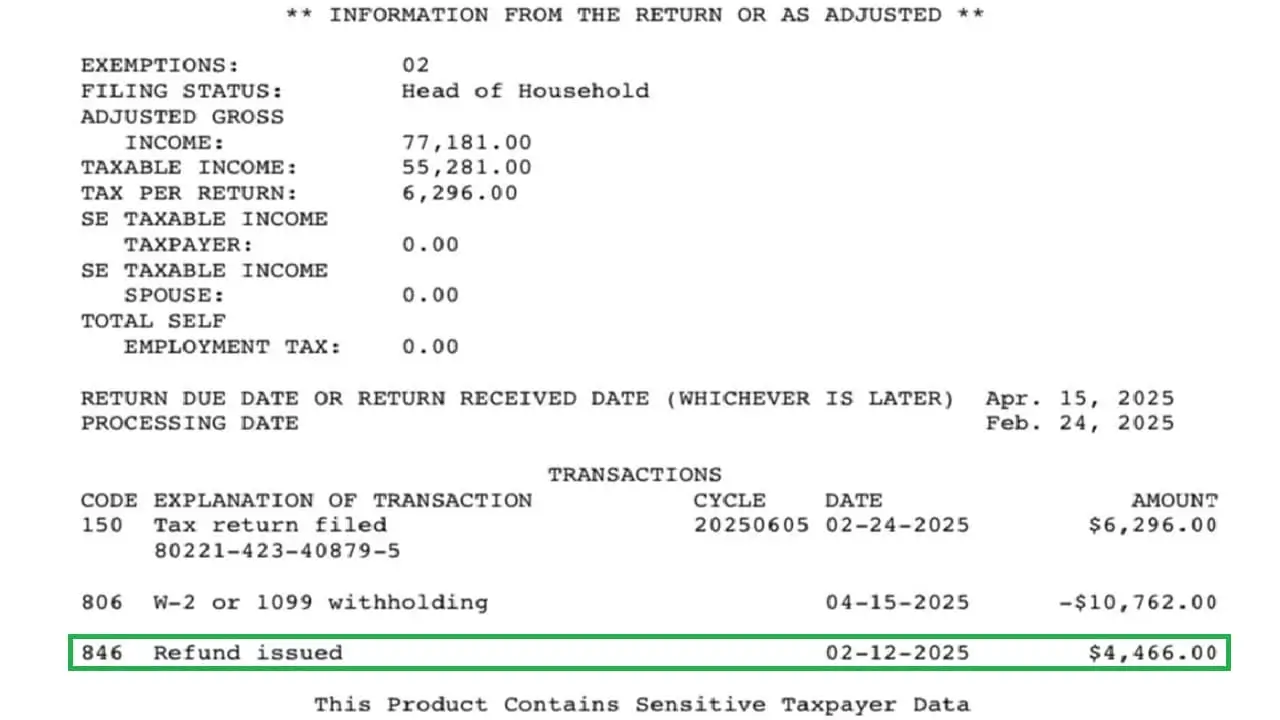
Does the date next to IRS Code 846 mean your deposit date?
No, the date next to IRS Code 846 is not always the same as your bank deposit date. The 846 date usually shows when the IRS issued or scheduled the refund on your account transcript, but the payment still has to move through the refund delivery method you chose.
If you selected direct deposit, the refund may reach your account quickly, but your bank still controls when it posts the money. The IRS also reminds taxpayers that transcripts do not always show a final deposit date, so the refund tracker is still the better place to check your current status. Weekends, holidays, bank processing rules, or a rejected account can make the deposit appear later than the transcript date. That is why checking your bank five times in one morning rarely helps.
Paper checks move slower. If the IRS mails your refund, the 846 date may show before anything lands in your mailbox, especially if there’s a weekend, holiday, address issue, or normal mail delay in between. And if your direct deposit details are wrong, the bank may reject the payment, which can push the refund into a different process.
So treat Code 846 as a strong refund signal, not a stopwatch. Match the date against Where’s My Refund, your bank activity, your mailing address, and any IRS notice before assuming something is wrong. If the date has passed and nothing shows, the next section will help you narrow down the cause.
If you are also looking at cycle codes, our IRS cycle codes refund timeline guide explains how transcript timing can create more confusion.
How do you check IRS Code 846 on your tax transcript?
You check IRS Code 846 by opening your tax transcript, choosing the correct tax year, and looking for the “Refund issued” transaction line. Use the IRS online account first, then compare what you see against your refund tracker and bank activity.
- Sign in to your IRS online account.
- Go to your tax records.
- Select the account transcript for the tax year you want to review.
- Scroll to the transaction section.
- Look for Code 846, “Refund issued.”
- Match the date and amount against your return, withholding, refundable credits, and deposit history.
Do not rush past the tax year. A prior-year refund, amended return, or old adjustment can show activity that looks current if you’re only watching the code. This is where people get turned around.
If you need a fuller walkthrough, use our tax transcript guide before guessing. Your tax transcript gives you the IRS account view, but it does not replace Where’s My Refund, bank records, or IRS notices. The smart move is to read the whole transaction list, not just one line. Code 846 matters. The surrounding entries tell the rest of the story.
What should you check before calling the IRS?
Before you call the IRS, check the facts that can explain why IRS Code 846 appears on your transcript but the refund is not in your account yet. The IRS says calling usually will not speed up a refund unless Where’s My Refund tells you to call, so start with the records you can verify first.
Check these items in order:
- Your refund status in Where’s My Refund.
- The tax year on the account transcript.
- The Code 846 date and refund amount.
- Your bank account or debit card activity.
- Your mailing address if a paper check may be involved.
- Nearby transcript codes, especially 570, 971, 841, or 898.
- Any IRS notice, bank message, or offset letter you received.
Don’t skip the simple details. A wrong routing number, old mailing address, weekend issue, or debt offset can make a refund look missing when the IRS already sent it through another path. The goal is to separate a real refund problem from a timing issue, because those are not handled the same way.
If your refund status is unclear after checking those items, use our guide on how to call the IRS before waiting on hold. Have your transcript, return, filing status, expected refund amount, and any notice in front of you. That preparation matters. It helps you ask a clearer question and avoid getting stuck in a conversation that only confirms what the transcript already showed. That saves time and keeps the next step grounded too.
Why can you have Code 846 but no money yet?
You can have Code 846 but no money yet because the IRS refund issue date and the actual payment arrival date are not always the same. That gap can happen with direct deposit, bank posting rules, mailed checks, rejected account information, refund offsets, or another IRS action after the refund was scheduled.
Common reasons include:
- Your bank has not posted the deposit yet.
- The issue date falls near a weekend or federal holiday.
- Your direct deposit account number or routing number was wrong.
- The bank rejected the refund because the account was closed or mismatched.
- The IRS switched the refund to a paper check.
- Part or all of the refund was taken for a qualifying debt offset.
- A later transcript code, such as 841, 898, 570, or 971, changed the story.
- The IRS needs more information before the refund fully clears.
- Your refund status on Where’s My Refund has not caught up with the transcript yet.
That does not mean you should assume the worst. Start by matching the Code 846 date, refund amount, tax year, and delivery method. Then check your bank activity, mailbox, IRS notices, and nearby transcript codes. A refund delay caused by normal bank timing is very different from one caused by an offset or rejected deposit.
The key is sequence. If Code 846 appears first and another code appears later, the later entry may explain why the money did not arrive as expected. If nothing else changed, you may simply be waiting for the payment path to finish. Annoying, yes. But not always a problem.
What if your refund was sent but still never arrived?
IRS Code 846 can show that a refund was issued, but delivery can still stall after that point. Two issues matter most here: a rejected direct deposit and a refund that may need a trace.
If the IRS cannot send your refund by direct deposit because the bank information is missing, invalid, or rejected, it may send a CP53E notice. You generally have 30 days from the notice date to add or update your bank information through your IRS online account or select an exception condition that allows a paper check. If you do not respond, the IRS says it will issue a paper check after six weeks, provided no other issue is blocking the refund. Paper checks are no longer the standard refund method, but they remain available in limited situations.
A refund trace is different. You may need one if the IRS shows the refund was sent but the money never arrives, or if a paper check was lost or stolen. Before starting a refund trace, check Where’s My Refund, review your bank activity, confirm your mailing address, and make sure enough delivery time has passed. Start with facts, not panic.
IRS Code 846 vs. other transcript codes
IRS Code 846 makes more sense when you read it beside the other transcript codes around it. One code can give you a clue, but the sequence usually tells the real refund story. That matters if your refund looks approved but the money still has not shown up.
| Transcript code | Plain-English meaning | What to check next |
|---|---|---|
| 150 | Return filed and tax calculated | Confirm the tax year and balance. |
| 806 | Federal withholding credited | Match it to your W-2s or 1099s. |
| 766 | Credit posted to your account | Check which credit created the refund. |
| 768 | Earned Income Credit posted | Watch for PATH Act timing or review delays. |
| 570 | Additional account action pending | Slow down. This can mean the IRS is holding something. |
| 971 | Notice issued | Read the notice before guessing. |
| 841 | Refund canceled or returned | Check for rejected deposit or returned check issues. |
| 846 | Refund issued | Match the date, amount, and delivery method. |
| 898 | Refund offset | Look for a debt offset notice or Treasury Offset Program issue. |
The mistake is reading Code 846 by itself. If 846 appears after credits and withholding, that usually points to refund release. If 570, 971, 841, or 898 appears near it, the refund may be delayed, adjusted, returned, or reduced. Use our IRS transcript codes tool if you need help comparing transcript codes instead of reacting to one line. A transcript is a timeline, not a single scoreboard. Read it that way before calling, amending, or assuming the IRS made a mistake based on one refund code.
What if your refund amount is smaller than expected?
If your refund amount is smaller than expected, do not assume Code 846 is wrong. The IRS may have issued the refund after reducing it for an adjustment, prior tax balance, or qualifying debt offset.
Start with the number beside IRS Code 846, then compare it to the refund shown on your filed return. If the amounts do not match, check for these issues:
- The IRS corrected income, withholding, credits, or math on the return.
- Part of the refund was used for a past-due federal tax balance.
- A state tax debt, child support debt, or other qualifying debt triggered an offset.
- A joint return created an injured spouse issue.
- You received, or will receive, an IRS notice explaining the change.
The IRS explains that a reduced refund can happen when the amount claimed on the return does not match what the IRS allows or when a debt offset applies. That notice matters. Read it before filing an amendment, calling the IRS, or assuming the bank made a mistake.
If the change involves your spouse’s debt on a joint return, look at the injured spouse rules. One refund can carry two people’s tax history. That is where the details start to matter.
When should you get help with an IRS refund issue?
You should get help with an IRS refund issue when the transcript, refund tracker, and IRS notices do not tell the same story. A short delay after Code 846 may just be bank timing, but repeated changes, confusing codes, or a reduced refund deserve a closer review.
Get help if you see:
- Code 570 or 971 after the refund looked ready.
- Code 898 and you do not understand the offset.
- A refund amount that does not match your filed return.
- Missing income, withholding, or credit information.
- A notice that changes your refund or asks for records.
- A rejected deposit, returned check, or old address problem.
This is where a tax professional can help you slow the issue down. H&S Accounting & Tax Services can review IRS transcripts, notices, refund adjustments, and tax account details when that work is separately scoped through our IRS tax problems service. The goal is not to guess. It is to compare the records and decide the next step.
FAQs about IRS Code 846
These FAQs cover the questions that usually come up after you see IRS Code 846 on a transcript. The code may look like a final answer, but the date, tax year, deposit method, and nearby codes can change what you should do next.
Does IRS Code 846 mean my refund is approved?
Yes, IRS Code 846 generally means the IRS has issued your federal refund or scheduled it for release. Still, approval and arrival are not the same thing. Check the date, amount, tax year, and delivery method before assuming the money should already be in your account.
Why did the 846 date pass but I still have no deposit?
The 846 date can pass before your bank posts the money. Weekends, federal holidays, bank processing rules, rejected direct deposit details, or a paper check can all slow things down. Start with Where’s My Refund and your bank activity before deciding something is wrong.
Can IRS Code 846 show for a prior tax year?
Yes. Code 846 can show on an older transcript when the IRS issues a refund, adjusts the account, or processes a later correction for that specific tax year. Don’t treat an old-year line like it belongs to your current refund. Check the transcript year first, then match the transaction date and amount.
What does Code 846 with Code 898 mean?
Code 846 with Code 898 usually points to a refund offset. That means the IRS may have issued the refund, but part or all of it was applied to a qualifying debt. Look for an offset notice and compare the transcript amount with the deposit received.
Does IRS Code 846 affect my state refund?
No. IRS Code 846 applies to your federal IRS account transcript, not your state refund. Your state refund has its own tracking system, rules, and processing timeline. If your federal refund shows issued but your state refund is missing, check your state tax agency separately.
Final takeaway on IRS Code 846
IRS Code 846 is usually a positive sign, but do not stop at the code. Read the whole refund picture: tax year, transaction date, amount, delivery method, and any nearby transcript entries.
If everything lines up, Code 846 likely means the refund issued and is moving through direct deposit, paper check, or another payment path. If the deposit is missing, smaller than expected, or followed by codes like 570, 841, 898, or 971, slow down. That is where timing, offsets, rejected deposits, or IRS notices can change what you should do next.
The smart move is simple. Verify the details before calling, amending, or assuming the IRS made a mistake. One line matters, but the full transcript tells the better story for you right now.