Form 1099-DA: Cost Basis Missing? How to File Accurately
Form 1099-DA can arrive with a gross proceeds figure and no usable cost basis. That does not mean the entire amount is taxable. Proceeds show what you received when the digital asset was sold or exchanged, while basis generally reflects what you paid, subject to applicable adjustments.
The broker reports proceeds to the IRS, so the amount on your return should not be guessed or ignored. Compare the form with your exchange history, wallet records, purchase confirmations, transfer details, and fees before calculating the gain or loss.
A filing mistake can start here. Entering zero basis may overstate the gain, while relying on incomplete records can produce a number you cannot support. First, determine whether the basis was properly omitted or the form is incorrect.
Quick answer and key takeaways
Quick answer: Yes, you can file when Form 1099-DA omits cost basis, but you cannot treat the form as complete. Under IRS guidance, use your records to determine basis, reconcile the broker’s proceeds with your transactions, and report an investment sale on Form 8949 and Schedule D. If the issuer reported incorrect proceeds or taxpayer information, request a corrected form.
Key takeaways
- Gross proceeds are not automatically taxable gain.
- Missing basis may be normal for a noncovered asset.
- A transfer can leave the receiving broker without purchase history.
- Report applicable transactions even if Form 1099-DA never arrives.
- Ask the issuer to correct inaccurate proceeds or taxpayer information.
- Keep records supporting the basis entered on your return.
What is Form 1099-DA and why did you receive it?
Form 1099-DA is a broker information return that reports proceeds and, in some cases, basis from digital-asset dispositions to you and the IRS. Its official name is Digital Asset Proceeds From Broker Transactions. It supplies tax-reporting information, but it is not your income tax return and does not calculate the gain, loss, or tax you ultimately report.
Who sends and receives the form?
Generally, a broker sends the form after facilitating a reportable digital-asset disposition. You receive a copy, and the broker sends the same reported information to the IRS. Compare the identifying details, proceeds, and any basis shown with your records before using the amounts on your return because the information return may not contain everything needed to calculate the taxable result.
Which transactions can appear on Form 1099-DA?
Form 1099-DA generally reports broker-facilitated sales, exchanges, and other dispositions of digital assets, as explained in the IRS guidance on reported transactions. These may include:
- A sale for U.S. dollars or another currency
- An exchange for another digital asset
- A payment for goods or services through a broker
- Digital assets used to pay certain broker transaction costs
Buying and holding are not dispositions. Moving assets between wallets you own is also generally not a sale by itself, although the transfer can affect what transaction history a broker has available.
Foreign-broker or noncustodial activity may not generate the form. If you used a centralized exchange, the same review applies to Coinbase taxes and similar platform activity. No form does not erase the underlying reporting requirement, so check your complete history for otherwise reportable sales, exchanges, or other dispositions.
Why is cost basis missing from Form 1099-DA?
Cost basis may be missing because the broker was not required to report it or lacked the asset’s full acquisition history. Basis is the amount used to measure gain or loss after applicable adjustments. A blank entry does not mean zero basis.
Covered and noncovered digital assets
Gross-proceeds reporting on Form 1099-DA began with 2025 transactions. Under IRS basis-reporting rules, mandatory basis reporting starts with certain covered-asset transactions after 2025; it remains voluntary for noncovered assets. Earlier acquisitions may show proceeds without basis. Current reporting thresholds address optional methods for certain stablecoin, NFT, and payment-processor transactions.
Why transferred assets may show no basis
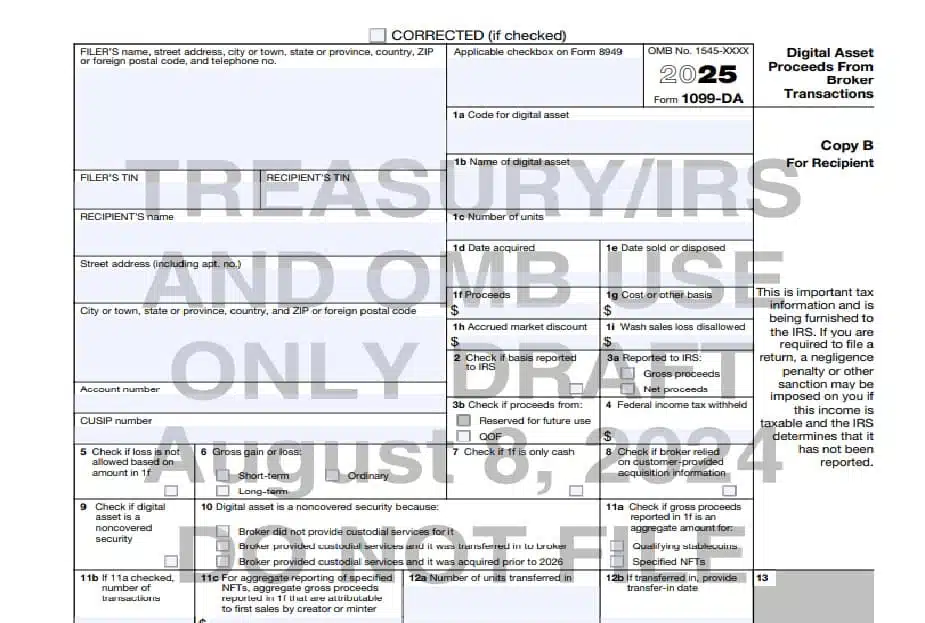
When assets move to another exchange or wallet, the receiving broker may not receive the original purchase date, cost, or fee history. Form 1099-DA may then report proceeds without basis. Trace both acquisition and transfer records before filing.
| Situation | Basis likely reported by broker? | Taxpayer's next check |
|---|---|---|
| Asset acquired from the same broker under covered-security rules | Generally required | Compare basis and holding period with purchase records |
| Asset acquired before covered-basis reporting began | May be omitted | Reconstruct basis from prior records |
| Asset transferred from another exchange or wallet | Often unavailable to the receiving broker | Trace the original acquisition and transfer path |
| Stablecoin or NFT reported under an optional method | Basis may be omitted | Apply the applicable transaction records and current rules |
What Form 1099-DA does not mean
| It does not automatically mean | What to understand instead |
|---|---|
| The full proceeds are taxable income | Basis and transaction classification determine the gain or loss. Gross proceeds alone do not. |
| A blank basis is zero basis | You may need to establish basis from reliable purchase, fee, and transfer records. |
| Every digital-asset transaction appears on the form | Some transactions and income types remain outside this broker statement. |
| No broker form means no reporting | Applicable gains, losses, and income may still require digital asset reporting. |
| The form is an IRS bill or audit notice | It is an information return used for tax reporting and IRS matching. |
| A broker-reporting threshold creates a tax exemption | Reporting thresholds govern the broker's filing duty, not whether your transaction is taxable. |
What should you check before filing?
Check the identifying information, reported proceeds, transaction history, cost basis, and holding period before using Form 1099-DA on the return.
Five-step verification sequence
- Match the taxpayer, issuer, account, and tax year.
- Export the complete exchange transaction history, not only the tax summary.
- Match reported proceeds with each sale and exchange. A mismatch may point to missing or duplicated activity.
- Reconstruct basis and holding period by wallet or account using reliable basis records.
- Save the documents supporting every adjustment or correction made on the return.
Records to gather
- Form 1099-DA and any corrected version
- Broker CSV or transaction export
- Trade confirmations
- Wallet transaction history
- Purchase records
- Transfer records
- Fees and transaction costs
- Prior-year basis reports
- Correspondence with the issuer
If your records span several exchanges or wallets, or the proceeds still do not reconcile, consider a professional tax-document review before filing.

2026 update: Notice 2026-20 extends temporary relief for identifying digital-asset units through December 31, 2026. Recheck or remove this update after that date.
How do you report Form 1099-DA on your tax return?
Investment sales and exchanges reported on Form 1099-DA generally move through Form 8949 and then Schedule D.
Investment sales on Form 8949 and Schedule D
Start with the proceeds reported to the IRS, then enter the supportable cost basis and the acquisition and disposition dates. Those dates determine whether the holding period is short term or long term. If the reported information differs from the amount used on your return, apply any permitted adjustment and code under the Form 8949 instructions. Carry the resulting totals to Schedule D using the Schedule D instructions.
When the transaction type changes the reporting path
Not every digital-asset item is an investment sale. After classifying the activity, answer the digital-asset question on Form 1040 accurately.
| Situation | General reporting route | What to verify |
|---|---|---|
| Sale or exchange of a digital asset held as an investment | Form 8949 and Schedule D | Proceeds, basis, date, holding period, and adjustments |
| Applicable disposal missing from the broker statement | Include it through the proper reporting path | Complete transaction history |
| Staking, mining, services, or other digital-asset income | May follow an income-reporting route rather than only Form 8949 | How and why the asset was received |
| Business or inventory-related digital assets | Facts may require different treatment | Business purpose, accounting records, and asset classification |
When should Form 1099-DA arrive?
Form 1099-DA recipient statements are generally due by February 15 following the transaction year, with the recipient deadline moving to the next business day when February 15 falls on a weekend or legal holiday.
| Situation | What timing to expect | When to take action |
|---|---|---|
| Standard recipient statement | By February 15 following the calendar year, adjusted when required | Check the broker portal and contact the issuer after the applicable deadline |
| Consolidated broker statement | Same general February 15 recipient rule | Review the full consolidated statement before filing |
| Corrected statement | No universal taxpayer-facing correction period is stated in the IRS recipient guide | Contact the issuer promptly and keep correspondence |
| Form never arrives | Reporting obligations may still exist | Reconcile your records and determine the proper filing treatment |
What if Form 1099-DA is wrong or never arrives?
Contact the issuer when reported information is incorrect, but do not assume a missing basis entry always requires a corrected form.
If the reported information is wrong
Compare the statement with your transaction records. If your name, taxpayer identification number, account details, or reported proceeds do not match, ask the issuer for a corrected form. The issuer makes the correction because the IRS does not revise a broker’s Form 1099-DA.
| Problem | Request correction? | Immediate action |
|---|---|---|
| Wrong name, taxpayer identification number, or account information | Yes | Contact the issuer and retain correspondence |
| Incorrect or duplicated proceeds | Yes | Compare transaction records and request a corrected form |
| Basis omitted for a noncovered asset | Not necessarily | Establish basis from personal records |
| Form sent for a transaction that is not yours | Yes | Contact the issuer immediately |
| No form received | Not automatically an IRS correction issue | Check broker records and report applicable transactions properly |
If the form never arrives
A missing form does not remove a reporting obligation. Reconcile your transaction records, then determine the proper filing treatment. Keep the original statement, any corrected version, and issuer correspondence.
When should you get professional help?
Professional review becomes more useful when Form 1099-DA cannot be reconciled from complete records or the transaction type is unclear.
Consider help when:
- Assets moved among several exchanges or wallets.
- A closed platform left gaps in your history.
- Basis reports from different systems do not agree.
- DeFi, staking, mining, NFT, or business activity changes the reporting treatment.
- You have many short-term and long-term transactions.
- Reported proceeds differ materially from your records.
- A prior return omitted digital-asset activity.
- The IRS sent a mismatch or examination notice.
You need to support the proceeds, basis, holding period, and transaction classification used on the return. If those figures cannot be reconciled reliably, tax preparation may be appropriate. Tax preparation does not automatically include IRS notice response, audit representation, penalty work, or year-round correspondence.
Form 1099-DA FAQs
Why does my Form 1099-DA show no cost basis?
Basis may be blank because the broker was not required to report it, the asset was noncovered, or it came from another wallet or exchange without complete acquisition history. Under the IRS basis-reporting rules, you still need records supporting the basis used on your return.
Does the form mean all the proceeds are taxable?
No. Gross proceeds show what you received from the disposition, not necessarily your taxable gain. Gain or loss depends on proceeds compared with adjusted basis and the transaction’s tax treatment. A blank basis should not automatically be entered as zero.
Do I report crypto if I never received the form?
Yes, if the transaction is otherwise reportable. Broker reporting and your tax obligation are separate. IRS digital asset reporting rules may still require a sale, exchange, or other taxable digital-asset transaction to appear on your return even when no information statement arrives.
What is the difference between this form and Form 1099-B?
This form is used for certain broker-reported digital asset dispositions. Form 1099-B generally covers sales of securities and certain other property. The reporting purpose is similar, but the assets covered and the rules for reporting cost basis are not the same.
What happens when crypto was transferred between my wallets?
A transfer between wallets you own is generally not a sale by itself. The complication is basis tracking. A receiving broker may lack the original purchase date or cost, so you may need records from the sending wallet or exchange to establish basis and holding period.
Who corrects an incorrect form?
The issuer handles corrections. The IRS does not revise the broker’s information return for you. If proceeds, taxpayer information, or another reported item is wrong, follow the IRS guidance, contact the issuer, and keep the original statement, corrected statement, and correspondence.
Final takeaway
Start with the proceeds, cost basis, transaction type, and records that support each digital-asset disposition. A missing basis entry on Form 1099-DA does not mean you should ignore the transaction, and it does not automatically mean the basis is zero.
Compare the broker statement with your exchange, wallet, purchase, and transfer records before filing. If the issuer reported inaccurate proceeds or taxpayer information, request a correction instead of forcing your return to match a form you know is wrong.
If you cannot establish the transaction history or tax treatment with reliable records, get help before filing. You can book a consultation if your records cannot be reconciled well enough to support the amounts reported on your return.