IRS Notice CP504: What this notice means and how to respond
Receiving IRS Notice CP504 means the IRS says an unpaid tax balance has reached a more serious collection stage. That deserves prompt attention, but the word “levy” does not by itself mean your bank account or wages are already being taken.
Start with the letter. Check the notice date, tax period, balance, and whether recent payments or an existing arrangement appear on your IRS account. A payment sent for the wrong tax year can leave the CP504 balance showing as unpaid even though money already left your bank.
The first question is not simply, “How do I stop a levy?” It is whether the IRS balance is correct and what collection stage your account is actually in.
Quick answer and key takeaways
Quick answer: IRS Notice CP504 is a Notice of Intent to Levy for an unpaid tax balance. It is serious, but it does not mean your wages or bank account are already being levied. The 30-day period matters because an eligible state tax refund can be levied after that period. Verify the tax period and balance.
Key takeaways:
CP504 means the IRS says a balance remains unpaid.
It does not prove a bank or wage levy is active.
CP504 differs from LT11 or Letter 1058.
Check the tax period, payments, and IRS account first.
If the balance is correct, payment or an arrangement may fit.
If it is wrong or already addressed, verify the account.
What is IRS Notice CP504?
IRS Notice CP504 is a balance-due collection notice the IRS sends when an assessed tax debt remains unpaid. It also serves as a Notice of Intent to Levy under IRC §6331(d), so the account has moved beyond earlier payment reminders. The amount shown can include the underlying tax, penalties, and interest.
The tax period on the notice matters. A CP504 for one year does not automatically tell you what is happening with every other year on your IRS account, so match the listed period and balance to your records before deciding how to respond.
The IRS guidance also explains that a Notice of Federal Tax Lien may be filed if one has not already been filed. That is separate from the levy warning itself.
Is CP504 the final notice before a levy?
IRS Notice CP504 is often described as a final balance-due notice, but it is not the same as an LT11 or Letter 1058 that gives Collection Due Process hearing rights before many other levy actions. The two notices do not give you the same appeal rights.
With IRS Notice CP504, an eligible state tax refund can be levied after the applicable 30-day period. Broader collection against wages, bank accounts, or other property generally involves a later hearing-rights notice if one has not already been issued. CP504 may also qualify for the Collection Appeals Program, which is different from a CDP hearing.
| Item | CP504 | LT11 / Letter 1058 |
|---|---|---|
| Main function | Balance-due Notice of Intent to Levy | Final levy notice with CDP hearing rights |
| Immediate issue | State tax refund may be at risk after the CP504 period | Broader pre-levy hearing-rights stage |
| Appeal path | CAP may be available | CDP request generally available |
| Primary form | Form 9423, where CAP applies | Form 12153 |
| First thing to check | Notice date, tax period, and balance | Printed CDP deadline and tax periods |
For the broader sequence, see IRS levy stages.
What should you verify before you pay or call?
Before paying IRS Notice CP504, make sure the notice, your IRS account, your filed return, and your payment records are all describing the same tax liability. A balance can look straightforward until a payment was posted to the wrong tax year, an adjustment changed the account, or an existing agreement was not reflected as expected.
Work through these checks first:
- Confirm the notice number is CP504.
- Write down the notice date and response information.
- Identify each tax period listed.
- Separate the tax, penalties, interest, and total balance.
- Check recent payments and the tax year or form they were applied to.
- Pull the relevant account transcript.
- Compare that transcript with the return you actually filed.
- Check whether an installment agreement or other account action should already appear.
- Pin down the exact disagreement before you call.
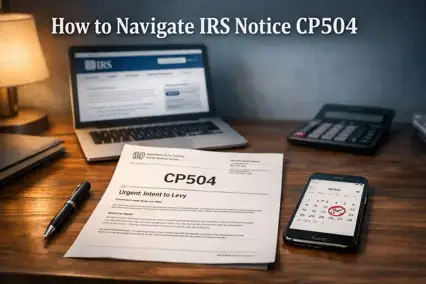
This order matters. The notice tells you what the IRS is collecting; the transcript shows what has posted to the account. Your return and payment records tell you whether those entries make sense. If the numbers do not line up, identify the mismatch before choosing a payment or dispute path.
What happens after IRS Notice CP504 if you do nothing?
If IRS Notice CP504 remains unresolved, collection can continue. The immediate CP504-specific risk is your state tax refund: the Taxpayer Advocate Service says the IRS can levy it if the amount due is not received within 30 days from the notice date. A later LT11 or Letter 1058 may follow before broader levy action if the required hearing-rights notice has not already been issued.
| Situation | What timing to expect | When to act |
|---|---|---|
| CP504 received | An eligible state tax refund may be levied after 30 days from the notice date | Before the period expires |
| Online bank payment through IRS Online Account or Direct Pay | Shows immediately in Payment Activity | Verify the tax year now |
| Debit or credit card | Usually appears in 1–2 days | Check after posting |
| Check or money order | May take up to three weeks | Keep proof and verify posting |
| LT11 / Letter 1058 arrives | Separate 30-day CDP period | Follow that notice's deadline |
IRS payment-posting times vary by payment method.
The IRS also states that the failure-to-pay penalty generally rises from 0.5% to 1% if tax remains unpaid 10 days after an intent-to-levy notice.
What should you do if the CP504 balance is correct?
If the tax period and balance on IRS Notice CP504 are correct, choose a payment route that matches what you can realistically pay. Ignoring a correct balance only leaves the collection issue unresolved.
- You can pay in full: Follow the payment instructions and make sure the payment is applied to the correct tax year and tax type.
- You cannot pay in full: Review whether an installment agreement fits. The IRS also allows qualifying individuals to apply through its Online Payment Agreement system and receive an approval-status notification after submitting the application.
- You already applied for a plan: Do not assume the request is approved. Check the actual status and keep following any instructions on the notice.
- The payment amount would create financial hardship: A standard payment plan may not be the right answer. Your full collection situation may need review before you commit to a monthly amount.
What if the CP504 balance is wrong, already paid, or already in an agreement?
Do not ignore IRS Notice CP504 just because you think the balance is wrong or you already took action. First, find out what the IRS account actually shows.
If the balance looks wrong: Compare the account transcript with the return you filed. Look for an additional assessment or a payment posted to a different tax period. Gather the records that support the specific disagreement before you respond.
If you already paid: Check the payment date, method, tax year, and form or payment type you selected. Keep the confirmation number, canceled check, or bank record. If the payment does not appear where expected, follow the IRS CP504 instructions and call the IRS using the number on your notice.
If you already have an installment agreement: Confirm that the agreement covers the tax period listed on CP504 and that IRS records reflect it. Continue making required payments unless the IRS tells you otherwise.
That review can change the response. In one intent-to-levy matter, reviewing the underlying returns showed that the collection balance itself needed further analysis before payment was treated as the answer.
Can you appeal IRS Notice CP504?
Yes. At the IRS Notice CP504 stage, you may be able to use the Collection Appeals Program, or CAP, to challenge certain collection actions. CAP is not the same as a Collection Due Process hearing.
For CAP, the IRS may direct you to Form 9423, Collection Appeal Request. The current CP504 guidance explains that you can request an appeal before collection action in qualifying situations.
CDP works differently. A CDP hearing is generally tied to a later notice such as LT11 or Letter 1058, which gives you a separate 30-day period to request a hearing. That request generally uses Form 12153. The IRS Appeals guidance explains those hearing rights and deadlines.
The distinction matters. CAP and CDP do not provide identical procedures or rights, so read the notice you actually received before choosing a form or assuming one appeal route applies.
What IRS Notice CP504 does not mean
A CP504 is serious, but it does not prove that every collection action has happened.
| Assumption | What to verify instead |
|---|---|
| “My bank account is already frozen.” | CP504 alone does not show that a bank has received a levy. |
| “CP504 is the same as LT11 or Letter 1058.” | Check whether the notice gives Collection Due Process hearing rights. |
| “The IRS definitely filed a federal tax lien.” | CP504 says a lien may be filed if one has not already been filed. |
| “I already paid, so I can ignore this.” | Confirm the payment posted to the correct tax period. |
| “The printed balance must be correct.” | Compare the notice and account transcript with your filed return and payment records. |
A payment posted to another year can leave the listed balance unresolved even though you already sent money.
When should you get professional help with CP504?
You may be able to handle IRS Notice CP504 yourself when one tax period is involved, the balance matches your records, all required returns are filed, and there is no payment discrepancy or later levy notice.
Consider professional review if:
- the balance conflicts with your return or transcript
- payments appear missing or were applied to the wrong period
- several tax years are involved
- returns are still unfiled
- an installment agreement is not reflected correctly
- LT11 or Letter 1058 has arrived
- self-employment or business issues complicate the balance
- a bank, employer, or another third party has received levy paperwork
Those situations can change which response makes sense. A tax resolution review can help identify what the IRS account shows before you choose the next step.
IRS Notice CP504 FAQs
How serious is IRS Notice CP504?
It deserves attention because the IRS is already trying to collect an assessed balance. Still, CP504 by itself does not tell you that your employer or bank has received levy paperwork. Look at the notice date and tax period first, then compare the amount due with your account records and recent payments.
Does CP504 come right before a wage or bank levy?
Not necessarily. CP504 has a specific consequence involving an eligible state tax refund after the applicable 30-day period. Wage and bank levies generally involve a later notice, such as LT11 or Letter 1058, that provides Collection Due Process hearing rights.
What can happen after CP504?
The collection process can move in several directions, so there is no single notice that must come next. Depending on the account, the IRS may pursue a state refund, file a federal tax lien when appropriate, or send a later notice carrying CDP hearing rights.
I already paid. Why did I still receive CP504?
Start with your IRS Payment Activity. Check where the payment was applied, especially the tax year and payment type. A payment can leave the CP504 balance open if it posted somewhere else. Keep the confirmation or bank record if you need to call.
Can I appeal CP504, and is CAP the same as CDP?
They are separate procedures. CAP may be available while the account is at the CP504 stage and can involve Form 9423. CDP usually becomes relevant after a later hearing-rights notice and generally uses Form 12153. The notice in front of you determines which procedure and deadline matter.
Final takeaway
IRS Notice CP504 should leave you with a specific job: figure out exactly what the IRS is collecting before you choose a response. Start with the notice number and tax period. Then compare the balance with your account transcript, filed return, and payment history.
If those records agree, decide how you will address the balance and act before the notice deadline. If they do not agree, identify the mismatch first rather than paying an amount you have not verified.
When the notice, transcript, and return tell different stories, a tax resolution review can help determine what the account shows and which issue needs attention before you respond.