
IRS Online Payment 2026: The Complete Guide
For years, paying the IRS was a deliberate, almost ceremonial chore. Taxpayers would sit down with a checkbook, fill in the four lines, and spend days waiting for the envelope to arrive at that Kansas City service center. The mantra was always “the check is in the mail,” a phrase that implied trust in the postal service and a hope that the cancellation date matched the April deadline. But times change.
In 2026, the landscape of federal payments is defined by the 2026 digital identity mandate, a push by the Treasury to move nearly all individual payments away from paper and toward a secure log in process. An IRS online payment is no longer just a convenience; for many, it is becoming the standard. This guide walks through each IRS online payment path currently available, explaining which tool fits a specific situation and, more importantly, how to verify the money actually left the account.
What is the IRS online payment system? (The 2026 update)
Back in the day, an IRS online payment meant logging on to a clunky website and hoping the connection didn’t drop mid-transaction. That era is effectively over. The definition of the term shifted dramatically in late 2025. Following the signing of Executive Order 14247, the Treasury Department began enforcing what many now call the digital identity mandate. The goal is straightforward: eliminate the paper check from the equation to cut down on fraud. Paper checks are reportedly sixteen times more likely to be stolen or tampered with than electronic funds.
So, what is an IRS online payment in 2026? It is the primary, and eventually the only, way to settle a tax bill. The system now encompasses everything from a quick debit card swipe to a scheduled bank draft, effectively relegating the mailing of a check to a niche exception rather than the norm. This shift isn’t just about technology; it’s about closing the windows of opportunity for financial fraud that paper provides. Mailing a check now feels less like a payment and more like a gamble.
Why the shift to digital? Speed and security
Because the mail is slow and check fraud is rampant. That is the simple math the Treasury finally accepted. Postal delays have always been a gamble; a check can sit in a processing facility for days before it is ever credited to an account. Every day the check sits in a sorting facility in, say, St. Louis is a day the taxpayer is technically unpaid. With digital payments, the numbers are confirmed instantly.
Why would anyone choose to wait? The security angle matters too. Paper checks carry a person’s full name, address, bank account, and routing number right on the face. When that envelope gets lost, that information is walking around in someone else’s hands. An IRS online payment eliminates that risk entirely, and the payment confirmation arrives within seconds instead of weeks. Most people just want to know the money is gone and the IRS is happy.
How to make an IRS online payment (Step-by-step)
There are actually four distinct paths to complete an IRS online payment, and choosing the wrong one can mean unnecessary fees or a delayed posting date. The first step is always the same: gather the tax return or the balance due notice with the CP14 code in the corner. That number is not optional. It is the key the system needs to match the payment to the correct account.
Option 1: IRS Direct Pay (The free option)
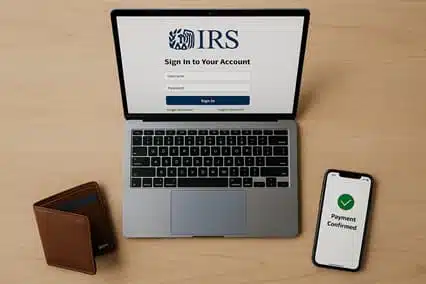
This is the Treasury’s preferred method for a reason. It costs nothing. A person navigates to the IRS Direct Pay portal on the official site, answers five questions about their identity, and pulls the money straight from a checking account or savings account.
This direct IRS online payment method allows scheduling up to 365 days in advance, which is useful for those who like to pay estimated taxes early and forget about them. The confirmation number generated at the end should be saved immediately. Screenshot it. Write it down. That number is proof.
Option 2: Pay by card or digital wallet
For those who want the credit card points or simply prefer the convenience of a card-based IRS online payment, the IRS allows payments via debit card, credit card, or digital wallet through third-party processors. There is a catch. These processors charge a fee, typically around 1.85 percent to 2.35 percent of the transaction. Paying a five-thousand dollar tax bill with a card might cost an extra hundred bucks in fees, so the math only works if the rewards outweigh the surcharge.
Option 3: Electronic Funds Withdrawal
This option is baked directly into tax preparation software like TurboTax or when working with a tax professional. During the e-file process, the software asks if the filer wants to pay now or later. Choosing to pay now initiates an Electronic Funds Withdrawal. The money leaves the account on the date the return is accepted. It feels like magic, but it also means the account needs to have the funds available that exact day, not just the day the return was signed.
Option 4: EFTPS (For businesses and power users)
The Electronic Federal Tax Payment System is the old guard. It requires enrollment and a waiting period to receive a PIN in the mail, which makes it useless for last-minute payments. However, for businesses paying payroll taxes or individuals making large estimated payments, it offers a granular level of control. The interface looks dated, but the system rarely fails. Once enrolled, an EFTPS transaction feels like moving money between two trusted bank vaults, just another form of IRS online payment that rarely raises eyebrows at the bank.
How to verify and track your payment
Sending the money is only half the battle. The other half is proving it left the account. After completing an IRS online payment, the system generates a confirmation number. That string of numbers is gold. Save it in two places. Maybe three. The bank portal will show the transaction as pending, but the IRS takes a minute to update their side. There is a gap there, usually about forty-eight hours, where the money has left the bank but the IRS systems haven’t flagged the account as paid.
Does the government work that fast? Never. To check official status, a person needs to log into their IRS account online or check the payment history through the same portal used to send the cash. If the return was filed electronically, the tax transcript will eventually reflect the zero balance. That transcript is the final word, the digital equivalent of a stamped receipt. Until it updates, holding onto that confirmation number is the only real security.
What happens if you don't pay online? (Common errors & fixes)
Skipping the digital route is possible, but the system is not designed for it. When payments fail or go manual, specific headaches appear. Here are the most common errors and their fixes.
- No bank account linked.Some taxpayers still operate on cash. Without a checking account or debit card, setting up an IRS online payment is impossible. The fix involves using a prepaid debit card or visiting a retail partner like 7-Eleven to pay with cash. The system generates a payment code that must be presented at the register.
- Ignoring the CP53E notice.The IRS sends this letter when an online payment fails due to mismatched information. Many toss it thinking it is spam. That notice contains instructions for reauthorization and a deadline. Missing it means the debt goes to collections.
- Waiting too long.A person who avoids paying online often waits until the last day and mails a check. The check arrives late. The penalty An IRS online payment is generally the smoother path.
Privacy and security: How to avoid scams
Scammers love tax season. The phone rings. A voice claims to be from the Treasury demanding immediate payment. The tone carries urgency, maybe a threat of arrest. Is it real? Almost never.
- The gift card demand.Any call demanding payment via gift card, wire transfer, or cryptocurrency is a scam. The IRS does not accept those.
- The fake website.Scammers build sites that look identical to the real portal. The only safe address for an IRS online payment ends in .gov. Not .com. Not .org.
- The text message link.The IRS will never text a link to “verify” an account. Those links steal passwords.
The best defense is skepticism. If a message makes the heart race, close the browser. Type the IRS address manually. Forward suspicious emails claiming to involve an IRS online payment to phishing@irs.gov. Then delete them.
How H&S accounting helps with digital tax payments
Helping with digital tax payments is where the real value shows up. A tax professional does more than just file paperwork.
- Reviewing the CP14 notice.That letter contains the exact figures. A quick review ensures the payment matches the balance.
- Handling failed payments.When a transaction bounces, a preparer can step in. They have the protocols to sort it out before penalties hit.
- Managing deadlines.Estimated payments arrive four times a year. Marking the calendar is easy. Remembering to log in is harder. The firm schedules the drafts so no one forgets.
Why wrestle with the portal alone? Whether guiding a client through an IRS online payment for the first time or reconciling the books after, having a second set of eyes changes the game. The payment should be the easy part. The rest is what we handle.
Frequently asked questions (FAQ)
Can I still mail a paper check?
Yes, for now, but the window is closing. Mailed checks carry risk. The post office now applies postmarks at the first regional facility, so a payment dropped on April 15 might not get that day’s stamp. Late is late.
What is a CP53E notice?
That letter arrives when the IRS cannot process a payment due to missing or incorrect banking information. The notice asks for updated details within 30 days. Ignoring it means delays. Responding through the IRS account online gets the money moving.
Can I use EFTPS in 2026?
Individuals can no longer enroll in EFTPS. That door closed in October 2025. Existing users can keep using it for now, but the IRS plans to sunset it for individuals completely. The replacement is IRS Direct Pay. Businesses can still use EFTPS normally.
How do I know an IRS online payment went through?
The system generates a confirmation number immediately. Save it. That is the receipt. Logging into the IRS account and viewing payment history shows the official status. The bank statement helps too, but that number is proof.
What if I pay on the wrong year?
It happens. A person makes an IRS online payment in January for last year’s taxes but selects the current year. The money lands in the wrong bucket. Fixing it requires a call to the IRS. The wait is long, but the alternative is a penalty for the correct year.
Can I pay without a bank account?
Yes, an IRS online payment is possible without one. Payments can be made with a debit card or credit card through authorized processors, though fees apply. Cash payments work at retail partner locations like convenience stores. The system generates a payment code to take to the register.
The new standard for IRS payments
The rules changed. Paper is fading, and making an IRS online payment is now the standard. The window for mailing checks is closing, and the risk of lost mail or misapplied funds is simply not worth it. That CP53E notice in the mailbox? Not spam. That confirmation number after paying? Save it. Screenshot it. The system works, but it works better with someone watching the edges.
A tax professional catches the errors before they become penalties, spots the missed deadlines, and flags the scams that look real. No one needs to wrestle with the portal alone. Call H&S Accounting. Let a professional handle the details while the focus stays on everything else. The payment should be the easy part. Make sure it actually went through. Then move on.