IRS Form W-4R: How to choose the right withholding rate
You’re ready to take money from an IRA or retirement plan, but the withholding question gives you pause. How much should you have taken out for federal taxes? The default percentage doesn’t tell you what you’ll actually owe. Withholding is tax paid ahead of time; your full year’s income and tax situation determine whether that payment covers enough.
Before you fill out IRS Form W-4R, identify the kind of retirement payment you’re receiving. That distinction affects which withholding choices you have. From there, look at the taxable amount and the federal tax you’re already paying through other sources. We’ll show you how to compare those numbers, choose an allowable percentage, and complete the form before your payment is processed.
Quick answer
IRS Form W-4R lets you set federal withholding on retirement payments that aren’t regular pension payments, including on-demand IRA withdrawals and certain eligible rollover distributions. The usual starting rate is 10% for nonperiodic payments, but eligible rollover distributions from employer plans paid to you generally require at least 20%. Choosing a different percentage depends on the rules for your payment. Identify that payment type, then estimate your yearly income and taxes already paid.
Who should use IRS Form W-4R, and is it mandatory?
You use IRS Form W-4R to request a different federal withholding rate for nonperiodic retirement payments or certain eligible rollover distributions, within the rules for your payment. Periodic payments generally mean regular installments over more than one year. An on-demand IRA withdrawal falls under the nonperiodic payment rules. See the IRS form guidance for the payments covered.
| Payment situation | Form or rule |
|---|---|
| On-demand IRA withdrawal | W-4R for a permitted withholding change |
| Certain eligible rollover distributions | W-4R, subject to withholding restrictions |
| Regular pension or annuity payments | Generally Form W-4P instead |
Withholding can be mandatory even when completing a new form isn’t. Your payer generally applies the required default if you haven’t made a valid different election. But a valid prior election generally continues for future payments from the same IRA or plan, as the current instructions explain. Don’t assume each withdrawal starts over at the default rate. Ask your payer which election applies to the upcoming payment before deciding whether you need to change it.
When does 10% or 20% federal withholding apply?
Nonperiodic distributions generally start at 10%
An on-demand IRA withdrawal generally starts with 10% federal withholding. Where allowed, IRS Form W-4R lets you elect any whole-number percentage from 0% to 100%. The default doesn’t establish your final tax bill.
Eligible rollover distributions generally require at least 20%
For an eligible rollover distribution from an employer retirement plan paid to you, 20% generally applies as a minimum. You can request more through IRS Form W-4R, but not less. An IRA withdrawal doesn’t fall under this minimum simply because you could roll it over. The IRS withholding categories distinguish these payments.
If the plan sends an eligible payment directly to another retirement plan or IRA as a direct rollover, withholding doesn’t apply. That’s different from receiving the money yourself and later rolling it over. See the rollover rules.
| Payment situation | Federal withholding starting point | Can you change it? |
|---|---|---|
| On-demand IRA withdrawal | Generally 10% | 0%–100%, where allowed |
| Eligible rollover distribution paid to you | Generally 20% minimum | Higher, but not lower |
| Direct rollover or trustee-to-trustee transfer | No withholding | Outside this election |
| Regular periodic pension payment | W-4P rules | Use Form W-4P |
Distributions excluded from the eligible rollover category
Required minimum distributions, the withdrawals retirement rules require, and qualifying hardship payments aren’t eligible rollover distributions. Don’t apply the mandatory 20% rule merely because the money comes from an employer plan.
How much tax should you withhold from an IRA withdrawal?
Choose a permitted rate that fits the tax you expect the withdrawal to add and any gap in your other tax payments. The 10% default may be too little, or more than you need. IRS Form W-4R changes withholding; it doesn’t decide how much is taxable.
For an on-demand IRA withdrawal, the percentage comes after you’ve checked the numbers.
- Use the taxable portion. If your withdrawal includes money excluded from income, omit it when estimating tax. You may receive more than you report as taxable income under the IRA distribution rules.
- Your other income matters here. Wages, pensions, investments and business earnings belong in the same annual tax estimate as the withdrawal. Account for your filing status, deductions and credits, then deduct the withholding and estimated payments you expect to pay. Include them in your tax planning. See IRS estimated tax guidance for how payments are treated.
- Calculate the tax the withdrawal adds. Compare your projected tax with and without the taxable payment. A larger withdrawal can put some income into a higher tax bracket, so multiplying everything by one rate may miss the difference.
- Compare that tax with an allowed election. Use IRS Form W-4R to select a permitted percentage, accounting for tax on other income that your existing payments haven’t covered.
If other income already leaves you short, withholding only the withdrawal’s additional tax won’t cover that gap. The percentage on IRS Form W-4R may need to reflect both.
How to use the IRS marginal rate tables
Compare your income before and after adding the taxable retirement payment in the table for your filing status. The IRS marginal rate tables on IRS Form W-4R show the rate that applies to each income range. If both amounts fall within the same rate, the instructions direct you to enter that percentage on Line 2, subject to withholding minimums and other tax needs.
Crossing into a higher range takes another calculation. The higher rate applies only to dollars in the higher range. Calculate tax separately for each portion; the combined tax divided by taxable payment gives a percentage, and round up to whole percentages.
For this illustration, split a taxable $20,000 payment into $15,000 at 12% and $5,000 at 22%. These amounts show the arithmetic, not bracket thresholds or a recommended withholding rate.
| Portion of payment | Marginal rate | Tax |
|---|---|---|
| $15,000 | 12% | $1,800 |
| $5,000 | 22% | $1,100 |
| $20,000 total | Combined | $2,900 |
The table gives $2,900 in estimated tax on the payment. Divide that by the $20,000 taxable amount to get 14.5%, then round up to 15%. Enter 15 on Line 2 of IRS Form W-4R only if the payment’s withholding rules permit that percentage.
The tables assume you’re already covering tax on other income through withholding or estimated payments, after accounting for deductions and credits. Any unpaid gap from that income may call for more withholding than this calculation gives you. A blended 15% also wouldn’t override a mandatory 20% minimum.
How to complete and submit IRS Form W-4R
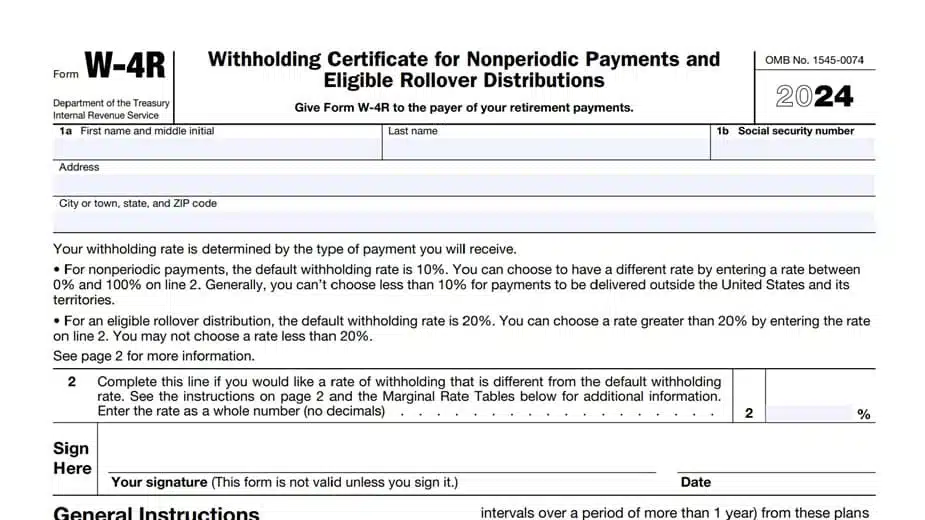
Submit IRS Form W-4R to whoever pays your retirement distribution. You don’t send it directly to the IRS. The entries are brief, but Line 2 needs attention: leaving it blank and requesting no withholding aren’t the same thing.
- Start with the current form. Get the latest version from the IRS official form page or your payer. Fill in your name and address on Line 1a and your Social Security number on Line 1b. An estate uses its employer identification number, or EIN, instead.
- Your payer can identify the payment category. Get that answer before choosing what goes on Line 2. When accepting the applicable default and no new election is needed, leave that line blank. To request zero withholding where allowed, write “-0-” rather than leaving an empty space, following the completion instructions.
- Write the percentage you want to use. Enter a whole number without decimals on Line 2 when changing withholding. You can’t elect less than 20% for an eligible rollover distribution subject to that minimum. A higher percentage is still allowed.
- Sign it, then enter the date. Filling in your information and withholding percentage doesn’t make the form valid; you need to sign it.
- Check the payer’s submission process. Some payers accept a substitute form or an electronic election instead of IRS Form W-4R. Confirm which method they accept and when your election will take effect for the payment you’re requesting. Don’t assume every payer processes changes on the same schedule.
What is the difference between Form W-4P and IRS Form W-4R?
With retirement payments, start with the arrangement: pension or annuity installments over more than one year generally use W-4P. IRS Form W-4R applies to specified nonperiodic payments and eligible rollover distributions, rather than those regularly scheduled pension installments. The payment arrangement matters, as the Form W-4P guidance explains.
| Form | Generally used for | How withholding is set |
|---|---|---|
| W-4P | Periodic pension or annuity installments | Filing status and other entries guide the calculation |
| W-4R | Nonperiodic payments and eligible rollover distributions | A percentage, subject to the payment's rules |
An IRA withdrawal you request on demand generally falls under the nonperiodic rules. Don’t assume a payment uses W-4P simply because it comes from a retirement account, or choose W-4R just because you prefer entering a percentage.
For wages from a job, use the separate employee Form W-4; neither retirement withholding form replaces it.
What happens if you withhold too little or too much?
Withholding counts toward the tax on your return. The percentage you choose on IRS Form W-4R affects how much you prepay, not how much of the withdrawal is taxable.
| Withholding amount | What happens when you file |
|---|---|
| Too little | You may owe a balance and an estimated-tax underpayment penalty, depending on your circumstances. See IRS guidance on withholding and estimated tax. |
| Too much | Excess withholding can generally contribute to a refund. A higher percentage doesn't reduce taxable income or guarantee that you won't owe. |
An estimated payment is another way to cover a shortfall. Your withdrawal may be only part of what’s unpaid. Include your wages, pensions and their withholding in the calculation; bring those records to a tax preparation review. For the payment itself, IRS online payment options explains which payment reason and tax year to select. Calculate the amount separately.
An early distribution’s additional tax is a separate charge from income-tax withholding. Don’t treat the percentage on IRS Form W-4R as the withdrawal’s total tax cost.
When are your withholding choices restricted?
A lower projected tax bill doesn’t always mean you can request less withholding. IRS Form W-4R has limits tied to the payment category, delivery location and taxpayer information.
- For eligible rollover distributions paid to you, the mandatory 20% minimum still applies. You can increase withholding, but you can’t elect a percentage below that minimum.
- If the payer sends your payment outside the United States and its territories, you generally can’t choose less than 10%. That includes a request for zero withholding. The delivery rule is separate from whether you’re a nonresident for tax purposes.
- Nonperiodic payments have an SSN restriction. A payer may not honor reduced withholding when you haven’t provided your Social Security number or when the IRS identifies that number as incorrect.
- Nonresident aliens and foreign estates generally use other withholding rules. The instructions specifically tell these recipients not to use this form.
Read the withholding restrictions for these exceptions before asking the payer to apply a reduced percentage.
Frequently asked questions about retirement withholding
Where can I download a printable IRS Form W-4R?
Download the current IRS form from the official IRS page, which also links to the PDF. The PDF updates to the current revision. Your payer may supply its version or accept another submission method. Check what it accepts before printing and sending the form you’ve downloaded.
Can I change an IRS Form W-4R election after submitting it?
Yes. Send a new valid election to the same payer under the updated election rules. Your previous election generally continues for future distributions from that plan or IRA until you change it. Ask when the replacement will take effect if you have a payment coming up.
Do separate retirement accounts need separate withholding elections?
The instructions describe an election for payments from the same plan or IRA. With several accounts or payers, confirm how each handles withholding. Don’t assume an election submitted for one IRA covers another account, even if you’re using the same percentage for both.
Does changing withholding change whether an IRA withdrawal is taxable?
No. Your payer withholds a tax payment from the withdrawal; IRA tax rules determine how much is taxable. You’ll account for that payment on your full return, but changing it doesn’t make the withdrawal a direct transfer or rollover or change how much is taxable.
Check these details before your withdrawal is processed
Have these answers before you submit IRS Form W-4R:
- Confirm the paying account and the distribution category with your payer.
- How much belongs in taxable income? Any excluded portion stays out of your tax estimate.
- Check the default percentage against the rate you’re requesting. Your election must fit the payment’s rules.
- Include your other income, withholding and estimated payments in the tax estimate for the full year.
- Sign and date the form.
- Follow your payer’s delivery instructions and ask when the election takes effect. No fixed IRS-wide processing window applies.
Several income sources or an uncertain tax projection may call for tax-preparation help. To review your situation, schedule a consultation.