Form 941 may be filed on time and still leave your business exposed to a payroll tax deposit penalty. That is because the quarterly return comes after some of the deposits reported for the quarter were already due.
The return brings several records together: wages paid, federal income tax withheld, Social Security and Medicare taxes, deposits already made, and the dates those tax liabilities arose. Those dates matter. A deposit made before the filing deadline can still be late if your monthly, semiweekly, or next-day deadline had passed.
This guide explains who must file, which payroll records to gather, how the key lines work, and how to reconcile tax liability with EFTPS deposits. It also covers filing versus deposit deadlines, prior-quarter corrections, and professional review.
Quick answer and key takeaways
Quick answer: Form 941 gives the IRS a quarterly breakdown of wages paid, federal income tax withheld, plus the employee and employer portions of Social Security and Medicare payroll taxes. Filing the return and depositing taxes are separate duties. Deposits may be due monthly, semiweekly, or the next business day, before the return is due.
Key takeaways
- Most employers file quarterly.
- Prior liability determines your regular deposit schedule.
- Payroll frequency does not set deposit frequency.
- Filing does not make a late deposit timely.
- Line 16 records liability dates, not payment dates.
- Schedule B reports liability dates for semiweekly depositors.
- Tax reaching $100,000 triggers a next-day deposit.
Review whether your payroll services scope assigns deposits, quarterly returns, and year-end forms.
What is Form 941, and who must file it?
Form 941 is an employer’s quarterly federal tax return for reporting wages, federal income tax withheld, and Social Security and Medicare taxes. Most employers file it after each calendar quarter once they begin paying covered wages.
The obligation continues in later quarters, even when no payroll runs. A no-wage quarter does not close the filing requirement. The IRS Form 941 instructions explain exceptions for seasonal employers and final returns, including boxes and supporting details that must be completed. Contractor payments stay separate because they are not employee wages.
| Employer situation | Filing treatment | Important condition |
|---|---|---|
| Regular employer | File quarterly beginning with the first covered-wage quarter | Continue filing later quarters unless an exception applies |
| Seasonal employer | May skip quarters without wages | Use the seasonal-employer box correctly |
| Business permanently stops wages | File a final return | Mark the final-return box, enter the last wage date, and provide the required statement |
| IRS-authorized annual filer | File Form 944 | Annual filing applies only after IRS authorization |
| Agricultural employer | Generally file Form 943 | Agricultural wage rules apply |
| Household employer | Generally report on Schedule H | Household employment taxes stay off the quarterly employer return |
| Contractor-only payer | Do not report contractor payments here | Independent-contractor pay is not employee wages |
What records should you gather before starting?
Gather records before entering totals on Form 941:
- A detailed payroll register showing each pay date and employee.
- Quarter-to-date totals for wages, tips, federal withholding, and taxable Social Security and Medicare wages.
- A payroll tax liability report organized by wage-payment date.
- EFTPS payment history and deposit confirmations.
- The prior-quarter return, plus Schedule B.
- Records for tips, sick pay, taxable fringe benefits, and Form 8974 if claiming the research credit.
- Notices, prior corrections, and overpayments applied to this quarter.
- Your EIN, legal name, address, and confirmed deposit schedule.
Do not rely on one payroll summary. Line 13 should match deposits and credits applied to the quarter, while line 16 or Schedule B must follow the dates wages were paid. A deposit appearing within the quarter may still be late, and its payment date does not establish when the tax liability arose.
How do you fill out Form 941?
Business information and filing quarter
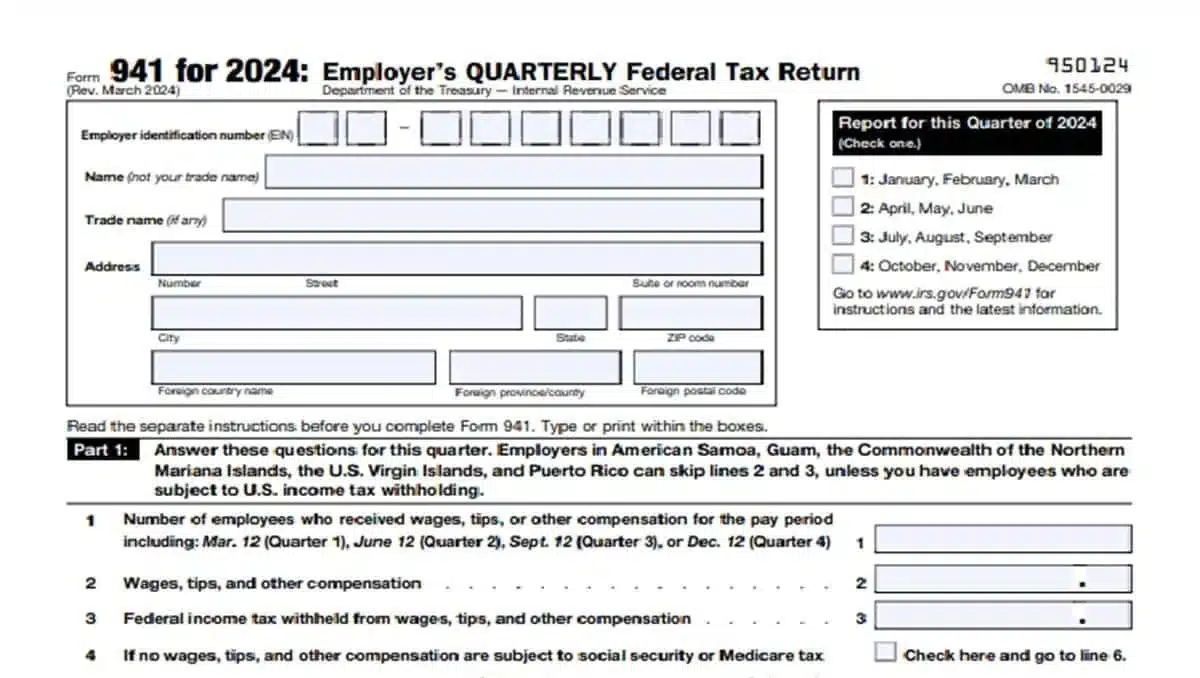
Copy the business name, EIN, and address from IRS records, then mark the quarter. Use the March 2026 revision throughout 2026. The quarter follows when wages were paid, not when you prepare Form 941.
Lines 1 through 12
Line 1 covers employees paid in the pay period including March 12, June 12, September 12, or December 12. It is not everyone paid during the quarter. Lines 2–3 report compensation and federal withholding. Lines 5a through 5d calculate Social Security, Medicare, and Additional Medicare Tax. Wage bases can differ from line 2 because pretax deductions are taxed differently and Social Security has an annual wage base. Enter adjustments on lines 7 through 9, a research credit from Form 8974 on line 11, and the resulting tax on line 12.
| Line | Entry | Check |
|---|---|---|
| 1 | Employee count | Designated pay period |
| 2–3 | Compensation and withholding | Payroll totals |
| 5a–5f | Taxable wages, tips, and taxes | Correct bases and rates |
| 6–12 | Tax, adjustments, and credit | Recalculate line 12 |
| 13 | Deposits and applied overpayments | EFTPS records |
| 14–15e | Balance due or overpayment | Refund details when applicable |
| 16 | Liability by wage-payment date | Equals line 12 |
Lines 13 through 15e
Line 13 reports deposits and applied overpayments. It does not show when liability arose. When line 12 is larger, report the difference on line 14. An excess on line 13 goes to 15a; choose to apply it to the next return or request a refund. Complete lines 15c–15e only for direct deposit. Never enter amounts on both lines 14 and 15a.
Parts 2 through 5
Use Form 941 line 16’s de minimis box when current- or prior-quarter line 12 is under $2,500 and no $100,000 next-day obligation arose. If only the prior quarter qualifies and current line 12 is $100,000 or more, report the liability. Otherwise, monthly depositors list liability by month; semiweekly depositors attach Schedule B. Liability must equal line 12. That match does not prove timely deposits.
Part 3 identifies a final return or seasonal employer. Part 4 authorizes a designee. An authorized person signs Part 5; an unsigned Form 941 is incomplete.
Why are filing and deposit deadlines different?
The deadlines differ because the quarterly return reports completed payroll activity, while deposits move employment taxes to the Treasury as wages are paid. Form 941 comes due after the quarter closes. A required deposit may already be weeks late by then.
| Obligation | Usual deadline | What sets the date |
|---|---|---|
| Quarterly return | April 30, July 31, October 31, or January 31 | End of the reporting quarter |
| Extended filing | Tenth day of the second month after quarter-end | Available only when all deposits were timely and paid in full |
| Monthly deposit | Generally the 15th of the following month | Wages paid during the month |
| Semiweekly deposit | Following Wednesday or Friday | The day employees were paid |
| Limited $2,500 exception | Pay with a timely return or deposit by its due date | Current or prior-quarter line 12 must be under $2,500, with no $100,000 next-day obligation |
Filing the return on time does not repair a late deposit. If you had to deposit payroll taxes earlier, paying that amount with the return can still trigger a failure to deposit penalty. The 10-day filing extension does not postpone a deposit. Check the IRS deposit rules against each payroll date instead of relying on the quarterly filing deadline for deposit timing.
Which payroll tax deposit schedule applies?
The IRS determines your regular deposit schedule from employment taxes reported over a four-quarter lookback period. Payroll frequency does not decide it. For 2026, combine line 12 from Forms 941 covering July 1, 2024, through June 30, 2025. A later amended return does not change that lookback total. Use the liability originally reported for each quarter in the window.
| Lookback result or event | Deposit rule | Due date |
|---|---|---|
| $50,000 or less | Monthly | Taxes on wages paid in one month must be deposited by the following month's 15th day |
| More than $50,000 | Semiweekly | Taxes from Wednesday-Friday paydays are due the following Wednesday; taxes from Saturday-Tuesday paydays are due the following Friday |
| New employer | Monthly | Lookback liability starts at zero unless the $100,000 rule applies |
| Accumulated liability reaches $100,000 during a deposit period | Next-day | Deposit by the next business day, regardless of the regular schedule |
Monthly does not mean filing a return every month. Semiweekly does not automatically mean two deposits each week, either. The actual number of deposits follows your pay dates and the tax liability accumulated in each deposit period. Weekend and legal-holiday rules can move a due date.
A monthly depositor that reaches $100,000 becomes a semiweekly depositor the next day and stays on that schedule for the rest of that calendar year and the following year. Semiweekly depositors also attach Schedule B, reporting liability by wage-payment date. Recalculate your status each year using the IRS deposit rules because the lookback window changes.
What does Form 941 not mean?
The return combines taxes, deposits, and liability dates, but those figures differ. Misreading them can make a return look correct while deposits remain late.
| Misconception | What it actually means |
|---|---|
| Filing the return by deadline proves deposits timely | Filing and deposit due dates are separate. Each required deposit is measured from payday. |
| Line 16 records deposits made | It reports tax liability by wage-payment date. Deposits and applied overpayments appear on line 13. |
| “Monthly depositor” means employees are paid monthly | Monthly describes the deposit schedule, not payroll frequency. |
| A zero-payroll quarter automatically ends the filing requirement | Filing generally continues unless a seasonal exception applies or a properly marked final return closes the account. |
Matching totals do not prove all deposits were timely.
How do you file the return and pay any balance?
- Reconcile the return to payroll records, deposits, line 16, and Schedule B when required.
- Sign and date Form 941. An authorized person signs Part 5; a paid preparer completes the preparer section.

- E-file employment tax forms through approved software or an authorized provider, then save the IRS acknowledgment.
- For paper filing, check the current mailing address before mailing. The correct address depends on your location and whether payment is enclosed, and addresses can change.
- Pay line 14 electronically using a business payment method. Paying with the return does not replace deposits that were due earlier.
- If the current instructions permit a check or money order, complete Form 941-V, write the EIN and quarter on the payment, and mail it to the “with a payment” address. Keep a copy, proof of filing, and payment confirmation.

Which mistakes can cause penalties, and how do you correct them?
Errors on Form 941 can trigger different penalties, so identify what failed before trying to correct it. A timely return does not erase a late deposit, and a correct quarterly total does not fix liability reported on the wrong payroll dates.
| Mistake | Possible result | Correction |
|---|---|---|
| Filing Form 941 after its due date | Failure-to-file penalty based on unpaid tax | File the return promptly and pay the permitted balance. Respond separately if the IRS assesses a penalty. |
| Paying a permitted return balance late | Failure-to-pay penalty and interest | Pay as soon as possible; do not confuse this balance with deposits due earlier. |
| Depositing late, short, or by an improper method | Failure-to-deposit penalty of 2%, 5%, 10%, or 15%, depending on lateness and notice timing | Make the deposit correctly, then reconcile the payment date and amount to payroll liability. |
| Reporting deposits on line 16 or using line 16 instead of Schedule B | An averaged deposit penalty may apply | Report tax liability by wage-payment date and amend the liability schedule when permitted. |
For an error in a prior quarter, generally file a separate Form 941-X for each affected quarter. Do not net the old-quarter adjustment into the current return. First trace the mismatch through payroll registers, deposit confirmations, line 16, and Schedule B. Broader payroll errors may also require corrected wage statements or state filings.
Can you file it yourself, or should you get help?
You can file Form 941 yourself when payroll is straightforward, records reconcile, and you understand deposits versus liabilities. Prior errors or missed deadlines change that assessment.
| DIY may be reasonable | Get professional help |
|---|---|
| Single-state payroll with consistent pay dates | Multiple states, tipped wages, or taxable fringe benefits |
| Payroll register matches deposits and line 16 | Lines 12, 13, and liability records do not reconcile |
| Deposit schedule and deadlines are confirmed | Deposits were late, short, or applied to the wrong quarter |
| No corrections or IRS correspondence | A 941-X, Schedule B correction, or IRS notice requires action |
Before relying on a payroll provider, confirm its scope in writing. Processing paychecks does not automatically include making federal deposits, filing quarterly returns, correcting prior filings, or responding to notices. You generally remain responsible under federal tax rules when a third party misses a required action. If unresolved payroll tax problems involve penalties, missing returns, or disputed deposits, have the account reviewed before filing another quarter.
Frequently asked questions
Do you file Form 941 for a quarter with no payroll?
In most cases, yes. If the IRS expects this return, submit a zero return even when you paid no wages during the quarter. A seasonal employer may skip quarters without wages after checking the seasonal-employer box. You may stop only after filing a return marked as final.
What belongs on Forms 940 and 941?
FUTA is reported annually on Form 940. Form 941 covers federal income tax withheld and the employer and employee shares of Social Security and Medicare taxes each quarter. Filing one does not replace the other when a business must submit both.
Can you file the quarterly payroll return online?
Yes. File electronically with IRS-approved business tax software or through an authorized provider. A business taxpayer does not use the individual Free File program for this return. Save the filing acknowledgment so you have the documented IRS result showing acceptance or rejection.
Can payroll taxes be paid with the quarterly return?
Sometimes, but only under limited rules. Most employers must deposit employment taxes before the quarterly filing deadline. Paying a balance with the return does not cure late deposits. The $2,500 exception depends on line 12 and whether a $100,000 next-day deposit became due.
Which form corrects a prior-quarter payroll error?
Each affected quarter requires its own Form 941-X, Adjusted Employer’s Quarterly Federal Tax Return or Claim for Refund. Correct the old quarter separately rather than carrying the adjustment onto current return. Depending on the error, you may also need corrected Forms W-2 and W-3.
Do contractor payments belong on the quarterly return?
No. Payments to correctly classified independent contractors do not belong on the employer’s quarterly payroll return because they are not wages subject to employment tax withholding. Track them separately for Form 1099-NEC reporting. A worker treated as a contractor may be an employee under federal rules.
Final steps before filing Form 941
- Confirm the correct revision, EIN, business name, and quarter.
- Check line 1 against employees paid in the designated snapshot pay period.
- Reconcile wages, tips, and federal income tax withheld to the payroll registers.
- Match line 12 to line 16, or Schedule B when that schedule applies.
- Compare line 13 with EFTPS confirmations, overpayments, and credits claimed.
- Attach Schedule B if you are a semiweekly depositor or triggered the $100,000 next-day rule.
- Determine whether line 14 is a permitted balance payment or a deposit that was due earlier.
- Get the authorized signature, then save the return, IRS acceptance, and payment confirmations.
If the numbers still do not match, schedule a consultation before filing.